Aquarium Algae Types: Identify the 6 Kinds by Sight, Feel, and Smell
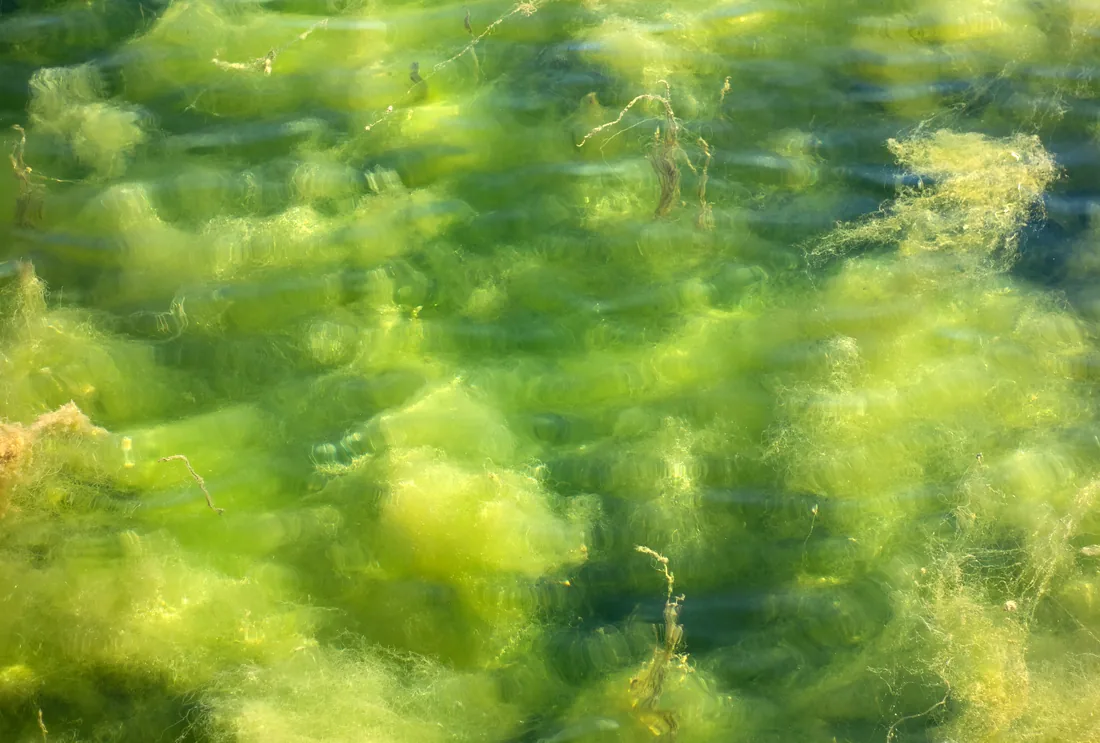
Table of contents
- Why "algae" is six different problems
- The 60-second identification table
- The six types, one at a time
- What actually drives each one
- The doses that work, by type
- Three things almost everyone gets wrong
- Hard water, soft water: different trigger
- What this guide will not do
- If there is a betta in the tank
- Aquarium algae — FAQ
Why "algae" is six different problems
Algae is not a species, it is a habit. Unrelated groups of organisms — green algae, red algae, diatoms, and one group of bacteria — all landed on the same trick: grow fast, grow cheap, and use whatever light and nutrients are left over. A freshwater tank is a machine for leaving light and nutrients over.
So the word "algae" is useless for diagnosis. Black tufts on a filter intake and brown dust on glass have almost nothing in common: one is a red alga responding to unstable carbon dioxide, the other a diatom bloom in a six-week-old tank. A product that fixes one does nothing for the other. Identify first, then buy.
The 60-second identification table
Look at the tank, then touch a small patch with a finger. Rinse your hands afterward, and never taste tank water. If the growth smears, it is not black beard algae. If it peels off in a slimy sheet that smells like a pond bottom, it is not an alga at all.
| Type | Where it grows | How it feels | Color | Smell |
|---|---|---|---|---|
| Black beard (BBA) | Filter intake, hardscape edges, slow-growing leaves like anubias | Stiff wiry tufts; will not smear | Near-black to dark green | Faintly earthy |
| Staghorn | Leaf edges, equipment in the current, substrate | Thin branching threads, brittle | Gray-green | Neutral |
| Hair / thread | Between stems, on moss, across the surface | Long slippery strands; Cladophora feels like cotton thread | Bright light green | Fresh, grassy |
| Green spot (GSA) | Glass, slow-growing leaves, rock | Hard and flat; a fingernail barely dents it | Dark forest green dots | None |
| Green dust (GDA) | Glass, mostly | Fine powder, wipes off in one pass | Pale green film | None |
| Brown diatom | Glass, substrate, leaves, decor | Soft dust that clouds the water when wiped | Rust brown | None |
| Cyanobacteria (BGA) | Low-flow corners, substrate, over plant crowns | Slippery sheet that peels off whole, with trapped bubbles | Blue-green to purple-brown | Strong earthy, swampy |
Two rows are worth memorizing. Anything that will not smear is black beard or green spot, and those two survive every "algae cure" on the shelf. Anything that smells like a wetland and peels off in a sheet is cyanobacteria — a bacterium, which changes the treatment completely.
The six types, one at a time
Black beard algae (Audouinella)
A red alga, which is why it does not look red: dense growth masks the pigments. It starts as fuzz on an anubias leaf edge or a filter intake, then lengthens into tufts a quarter inch to an inch (0.5–2 cm). Nothing eats it reliably, nothing wipes it off, and pulling it leaves fragments that regrow.
The most consistent trigger across hobby sources is unstable carbon dioxide — CO2 that swings during the day, or strong light with no injection at all. The second is organic matter collecting in a dead spot with no flow through it.
Staghorn algae (Compsopogon)
Another red alga, named for the branching: a clump looks like a set of tiny deer antlers about an inch (2.5 cm) across. It appears on leaf edges and on equipment sitting directly in the filter current — the opposite of where cyanobacteria shows up. Staghorn usually follows a disturbance rather than a steady imbalance: a filter cleaned too thoroughly, a food spike, an ammonia reading that came and went while you were not testing.
Hair and thread algae (Spirogyra, Cladophora, Oedogonium)
Three genera do most of the damage. Spirogyra is slippery and comes away in wet clumps. Cladophora is wiry, feels like cotton thread, and anchors hard. Oedogonium forms shorter tufts close to the surface it grew on. All three answer to the same thing: more light and nutrients than the plants can absorb. That is why hair algae dominates a new high-light tank with no CO2, and why it often collapses once the plants fill in.
Green spot and green dust algae
Both grow on glass and are easy to confuse until you touch them. Green spot forms hard dark dots that resist a sponge and need a razor blade or melamine pad; it also speckles anubias and bucephalandra in bright light. Green dust is a pale film that wipes off in one stroke and returns in two or three days.
Green dust is a new-tank phenomenon — weeks three to ten, fading as the tank matures, often in four to eight weeks with no intervention. Green spot is the opposite: a long-term imbalance, most often light stronger than the plant mass can use.
Brown diatom algae
Diatoms build shells from silica and bloom where silica meets low light. In a new tank that means a rust-brown dusting on glass, substrate, and leaf tops within the first month. Wipe it and the water clouds brown for an hour. Diatoms are self-limiting: once the silicate in the water column is used up, usually between week four and week eight, they fade on their own. Nerite snails and otocinclus graze them down in the meantime, and both work far better on diatoms than on anything else here.
Cyanobacteria (blue-green algae)
Not an alga, and treating it like one is why it keeps coming back. It is a photosynthetic bacterium that forms sheets rather than filaments: a slimy olive-to-blue-green mat that peels off in one piece, often with gas bubbles caught underneath, carrying an unmistakable swamp smell. It appears where flow is poor and oxygen is low — the corner behind the filter outlet, the gap between substrate and glass — and high phosphate makes it worse.
Handle it with gloves. Some cyanobacteria produce toxins. Do not let it touch an open cut, do not let pets drink the water, and wash your hands after syphoning it out.
What actually drives each one
Every algae problem comes down to four levers: light, nutrients, flow, and carbon. The type tells you which lever is out of range, so you stop moving the other three at random.
| Lever | Target for a settled tank | What breaks when it is off |
|---|---|---|
| Light duration | 6–8 hours per day on a timer | Over 8 hours favors hair algae and green spot; no timer favors everything |
| Nitrate (NO3) | 10–20 ppm | Near zero starves plants and hands the tank to algae; over 40 ppm feeds it |
| Phosphate (PO4) | 0.5–1 ppm | High phosphate plus low flow is the classic cyanobacteria setup |
| Turnover | 4–6 times tank volume per hour | Dead spots collect organic matter, which feeds BBA and cyanobacteria |
| Water changes | 30–50% weekly during an outbreak, 25–30% after | Irregular changes mean nutrient spikes — what staghorn responds to |
| Filter cleaning | Rinse sponges in removed tank water every 2–4 weeks | Tap-water rinsing kills bacteria; over-cleaning triggers staghorn |
If you change one thing this week, put the light on a timer. It is the cheapest lever, the one most tanks get wrong, and the one that shows a difference in two to three weeks. Our guide to live plants in a small tank covers species that tolerate six hours without melting.
The doses that work, by type
These are the numbers most consistently reported across hobby sources, not laboratory figures. Start at the low end, treat half the tank first, and watch the fish for an hour before doing the rest.
- Manual removal always comes first. Twirl hair algae around a toothbrush. Pull BBA tufts with tweezers. Scrape green spot with a razor blade held flat. Siphon cyanobacteria out rather than scrubbing — scrubbing spreads it into the water column.
- Black beard and staghorn: spot-dose a liquid carbon product such as Seachem Flourish Excel. The label rate is 5 mL per 10 US gallons (40 L) on day one, then 5 mL per 50 gallons daily. Filter off for 10 minutes, syringe it onto the tufts. They should turn pale pink or gray in three to four days, which means they are dead and can be pulled out.
- Stubborn BBA patches: 3% hydrogen peroxide at 1.5 mL per US gallon, spot-sprayed with the filter off, once per 24 hours, no more than three treatments. Do not exceed that rate, and do not use it in a tank with a heavy shrimp population — see the cherry shrimp guide for why invertebrates are far more sensitive than fish.
- Cyanobacteria: siphon it out, then run a 72-hour blackout — total darkness, tank wrapped in a blanket, no feeding, filter and surface agitation still running. Then fix the flow. A blackout knocks it back; only flow and cleanliness keep it away.
- Diatoms: wipe the glass and check back at week eight. Add nerite snails if the look bothers you.
- Green dust: wipe with filter floss weekly. It resolves as the tank matures.
Liquid carbon products are glutaraldehyde. They work, and they are also the fastest way to hurt shrimp and delicate plants if you double the dose "to be sure". Follow the label rate, and never combine a full dose with a peroxide treatment on the same day.
Three things almost everyone gets wrong
1. "An algae fix in a bottle will kill whatever is in my tank." Products sold as algae removers — API AlgaeFix is the best known in the US — are built around a polymer that clumps free-floating green algae so it can be filtered out. That makes them useful against green water and close to useless against black beard, staghorn, green spot, or cyanobacteria, all of which are attached growth. The label itself warns about invertebrates, and the algae returns within two or three weeks because nothing about the tank changed. The bottle treats what you can see; identify the type and move the lever instead.
2. "A three-day blackout cures any algae." A blackout is a real technique, but a narrow one. It works on cyanobacteria and green water, knocks back green dust, and does little to black beard or green spot, which survive on stored reserves. It also removes the light your plants need for three days, and if you run it with the filter off you can drop the oxygen far enough to stress the fish. Cover the tank, keep the filter and surface movement running, do not feed, and expect a repeat in a few weeks if you have not fixed the flow.
3. "Buy a Siamese algae eater and it will clean the black beard." The fish usually sold under that name is not one. True Crossocheilus species have a single jagged black stripe running all the way to the tip of the tail; on the flying fox and the Chinese algae eater — the two most often mislabeled — the stripe stops short or has a different shape. True Siamese algae eaters graze black beard mainly while young, and the substitutes mostly stop eating algae as adults. The Chinese algae eater is widely reported to attach to the slime coat of slow, flat-bodied fish, which describes a betta exactly. Do not buy a fish to solve a problem you have not diagnosed.
Hard water, soft water: different trigger
If your water is hard — much of the Midwest, the Southwest, and Florida on limestone, roughly 8–12 dGH and up — tap water carries phosphate and silicate along with the calcium. That favors green spot, green dust, and diatoms, and every top-off with tap water adds more. Test your tap phosphate once; above 1 ppm, top off evaporation with RO or distilled water and save the tap for water changes. The GH and KH guide covers the test and the dilution math.
If your water is soft — the Pacific Northwest, New England, most mountain-fed city supplies, 0–3 dGH — you get the opposite failure. Low carbonate hardness means pH and CO2 drift during the day, and that instability is the classic setup for black beard algae. Check KH before you blame the light: under 2 dKH the tank has no buffer, and a heavy fish load alone will push pH around enough to feed BBA.
Two things hold everywhere in the US. Most municipal supplies are treated with chloramine rather than chlorine, so a dechlorinator has to be labeled for chloramine — sitting water out does not remove it. And in heating season evaporation climbs, so top-offs matter more than they did in October.
What this guide will not do
This page identifies and treats attached algae in freshwater tanks. It does not cover green water, a free-floating bloom with a different fix — UV sterilizer or a 72-hour blackout, not scraping. It does not cover marine macroalgae, reef rock, or the coralline algae reef keepers deliberately grow. It does not diagnose plant nutrient deficiencies: yellowing leaves with holes are a fertilizer problem, and an algae product makes them worse.
It also will not rescue a tank that has lost its foundation. A tank four or more years old, with a deep undisturbed substrate, growing cyanobacteria in the same corner no matter what you change, usually needs a teardown and new substrate rather than another dose. That is a weekend project, not a bottle.
If there is a betta in the tank
Betta tanks stack several of these triggers. The volume is small, so a pinch of extra food moves nitrate fast. It runs warm — 78–80°F (26–27°C) — and algae grow faster warm. And bettas are kept with gentle filtration, which is right for the fish and wrong for flow, so dead spots are common and cyanobacteria gets a foothold in the calm corners.
The order of operations does not change: identify, fix the lever, then remove what is left. The risk calculation does. Bettas breathe at the surface, so a blackout with the filter off is more dangerous for them than for mid-water fish. A betta will not eat algae at any size, and adding a "cleaner fish" to a 5-gallon tank usually creates a second problem before it solves the first — see the tank mate guide for what is actually safe. One nerite snail is the lower-risk grazing option and is genuinely good at green spot and diatoms on glass.
For the routine itself — light schedule, feeding, water change rhythm — see our betta tank algae guide. This page is about telling the types apart so that routine targets the right one.
Related guides: Getting rid of algae in a betta tank · Nerite snails for algae control · GH and KH explained · Live plants for a small tank
Aquarium algae — FAQ
How do I tell black beard algae from staghorn algae?
Touch it. Black beard algae is stiff and wiry, grows in short upright tufts on hardscape and leaf edges, and will not smear when you rub it. Staghorn algae branches into antler-like threads about an inch across and is a duller gray-green. If the growth smears across the glass, it is neither one.
Does a three-day blackout kill black beard algae?
Not reliably. A blackout works against cyanobacteria and green water and barely touches black beard, which survives on stored reserves and regrows within weeks. Black beard responds better to spot dosing with a liquid carbon product or 3% hydrogen peroxide, plus stabilizing the carbon dioxide and flow in the tank.
Will nerite snails eat green spot algae?
Yes. Nerites are one of the few animals that graze hard green spot algae off glass and slow-growing leaves, along with otocinclus catfish, and they are much less useful against black beard or staghorn. They also cannot breed in freshwater, so a few will not turn into an infestation.
Is blue-green algae in a fish tank dangerous to people?
Treat it with respect. Cyanobacteria is a bacterium, not an alga, and some strains produce toxins. Wear gloves when you remove it, keep it away from open cuts, do not let pets drink from the tank, and wash your hands afterward. It is not a reason to panic, but it is a reason not to scoop it out bare-handed and then eat lunch.