Cherry Shrimp Care: Setup, Breeding, and the Mistakes That Wipe a Colony
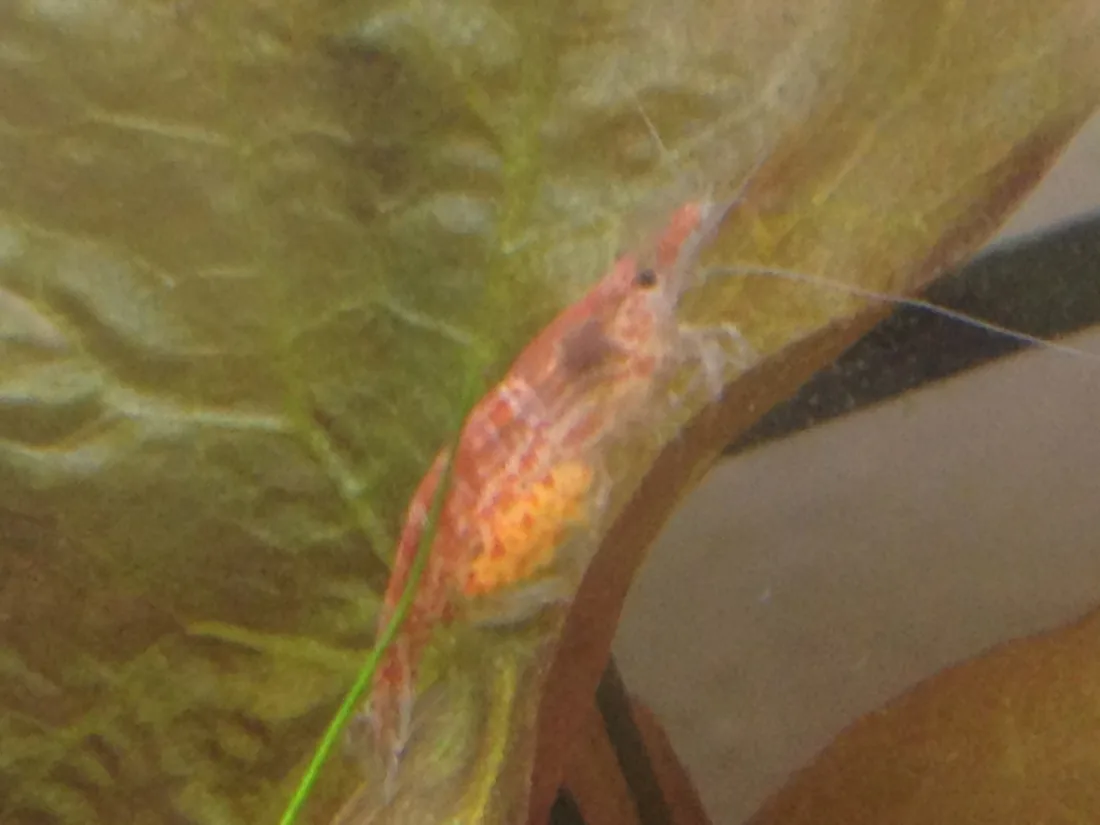
Table of contents
What cherry shrimp actually are
The cherry shrimp sold in shops is Neocaridina davidi, a small freshwater shrimp native to Taiwan and eastern China, formerly classified as Neocaridina heteropoda — you will still see both names in older sources. Adults reach roughly an inch, with females larger and much deeper-bodied than males. Wild-type animals are a translucent brownish-gray; the red form was line-bred for decades until "cherry" became the default beginner shrimp.
Color names are grades, not species. Cherry is pale red with translucent patches, Sakura is a denser red, Fire Red is deeper still and more opaque, and Painted Fire Red is the show grade where even the legs are solid color. All of them are the same animal with the same care, and all of them will lose grade over generations if you do not cull the paler ones.
The reason they are the classic beginner invertebrate is their life cycle: cherry shrimp have no larval stage. Eggs hatch as miniature copies of the adults. That single detail is why they are easy to breed in a home tank and also why they are so vulnerable — a shrimplet is small enough to be eaten by almost anything with a mouth.
The tank they want
A cherry shrimp colony does not need much space, but it does need the right kind of space.
- Size: a 5-gallon tank will support a colony; 10 gallons is far more forgiving because the water chemistry moves more slowly. Our tank size guide applies to shrimp for the same reason it applies to fish.
- Filtration: a sponge filter driven by air is the standard choice. It cannot suck up shrimplets, it provides a huge grazing surface for biofilm, and it does not create a current the shrimp have to fight. Hang-on-back and canister filters work, but you must cover the intake with a coarse sponge or you will find shrimp inside the filter.
- Planting: dense plants — mosses, hornwort, guppy grass, floating plants — are the single best investment. They are grazing surface, they are hiding space for molting shrimp and shrimplets, and they stabilise water quality. See live plants for a small tank for options that do not need special lighting.
- Hardscape and substrate: any inert substrate is fine. Add a piece of driftwood or cholla wood — the biofilm that grows on wood is a staple food, and the shelter helps during molts.
- Lid: shrimp do climb, and they do not survive the carpet. Cover the tank.
Above all, the tank must be fully cycled and mature. Not "cycled last week" — mature, with biofilm on every surface. A tank that has been running for two or three months with plants is drastically more successful for shrimp than a fresh setup, even if both read zero ammonia. If you are starting from scratch, read how to cycle a tank and then wait a few more weeks before adding shrimp.
Parameters: stable beats perfect
Here is the paradox of shrimp keeping: cherry shrimp tolerate a wide range of water, but they handle change very badly. Two colonies can thrive at completely different pH values, yet both can collapse if the pH moves half a point in a day.
Reasonable targets for Neocaridina davidi:
- Temperature: 65–78°F (18–26°C). Room temperature suits most homes; a heater is only needed if the room drops below about 64°F. If you do heat, heat steadily.
- pH: roughly 6.5–7.8. Do not chase a number. Chase stability.
- General hardness (GH): around 6–8 dGH. This is the parameter that decides whether shrimp molt successfully.
- Carbonate hardness (KH): roughly 2–5 dKH. Enough to buffer pH, not so much that it locks the water.
- TDS: many breeders keep a colony around 180–250 ppm. TDS is a convenient proxy: if it is drifting upward, you are not changing enough water; if it swings wildly, you changed too much.
The practical rules that follow from this:
- Change 10–20% a week, not 50% when you remember. Small and frequent is the whole trick.
- Match temperature and mineral content. Do not dump cold tap water into a warm tank. If your tap water is very soft or very hard, mix it or use a remineralised source so the new water is close to the old.
- Top off evaporation with RO or distilled water, because evaporation leaves minerals behind and top-offs with tap water slowly raise hardness and TDS.
- Use a dechlorinator that handles chloramine, and check whether your supplier uses it. Chlorine evaporates; chloramine does not.
If you are unsure how to read GH, KH and pH properly, our water testing guide covers the tests worth buying — the liquid drop kits, not strips.
Feeding without fouling the water
In a mature planted tank, cherry shrimp mostly feed themselves. They graze biofilm, algae, decaying plant matter and the microscopic life on every surface. That is their natural diet, and it is why a well-established tank is worth more to them than any food you can buy.
Supplement lightly — a small amount two or three times a week at most:
- Blanched vegetables: zucchini, spinach, kale or cucumber, weighted down, removed after 12–24 hours.
- Shrimp-specific pellets or wafers with a mineral content, which also help with molting.
- Botanical material: an Indian almond leaf or a piece of cholla wood, both of which grow biofilm as they break down.
- Calcium sources such as cuttlebone, if your water is soft.
Overfeeding is the most common beginner error and it is not really about the shrimp — it is about the water. Uneaten food decays, ammonia rises, and shrimp are far more sensitive to ammonia than fish are. When in doubt, feed less. The same principle governs feeding any small tank: the food you do not add is the cheapest water quality you will ever buy.
How breeding actually works
Cherry shrimp breed without any intervention once conditions are right. The sequence looks like this:
- A female molts and becomes receptive. Males swim around agitatedly, darting and searching — this "excited male" behavior is usually the first sign anything is happening.
- Mating happens shortly after the molt, while the female's shell is still soft.
- She becomes "berried": a cluster of 20–40 eggs appears under her tail, held between her swimmerets. She will fan and clean them constantly.
- About three to four weeks later the eggs hatch directly into miniature shrimp. There is no free-swimming larval stage, no special fry food, no separate raising tank required.
- Shrimplets are tiny and defenseless for the first couple of weeks. Dense moss is what keeps them alive.
What triggers breeding is simply stability plus food. Keep the parameters steady, keep the tank well fed with biofilm, and the colony will grow on its own — often faster than you expect. A dozen shrimp can become a hundred within a year in a heavily planted ten-gallon tank.
What suppresses breeding: swinging parameters, an empty tank with no biofilm, temperatures at the extremes, and constant disturbance. If your shrimp have stopped breeding, look at those four before you look for a product.
The four ways a colony dies
When keepers say "my shrimp just die for no reason", it is almost always one of these.
1. Copper
Copper is lethal to shrimp at concentrations that do not bother fish. It arrives from three places: fish medications (many ich and parasite treatments are copper-based), some tap water supplies (older plumbing, especially in soft-water areas), and "snail and shrimp killer" products that are essentially copper solutions. Read every label. If a fish in the tank needs a copper treatment, treat it elsewhere.
2. Big water changes and parameter swings
A 50% change with water of a different hardness can trigger mass molting, and a failed molt kills. Shrimp that die shortly after a water change, especially with a visible white band across the back of the shell (often called the "white ring of death"), are telling you the change was too abrupt or the GH is off.
3. An uncycled or crashing tank
Ammonia and nitrite burn invertebrates faster than they harm fish. A filter that gets rinsed in tap water, a substrate that gets stirred, or a tank that never finished cycling will kill shrimp gradually and confusingly, one or two a day.
4. Predators and planaria
Planaria (flatworms) and hydra will take shrimplets, and both usually arrive on new plants or live food. Quarantine plants, do not overfeed, and remove planaria with a trap rather than a chemical — most planaria treatments contain copper.
One more: molting problems from low minerals. If shrimp molt and die, or the new shell looks thin and pale, raise GH with a shrimp-specific mineral supplement rather than guessing.
Tank mates and the betta question
This is where most people get hurt. Cherry shrimp are small, soft, and exactly the size of a betta's idea of a snack. Betta keepers often ask whether shrimp can live with a betta, and the honest answer is: the adults might survive, the babies will not, and even the adults depend entirely on the individual fish's temperament.
A heavily planted tank with a calm betta and a large shrimp colony can work — the shrimp breed faster than the fish eats them, and the tank reaches an equilibrium. A bare tank with a hunting betta becomes an expensive feeding program. Our tank mate guide covers which species are genuinely safe; snails such as the nerite are a much lower-risk invertebrate for a betta tank.
Safe shrimp companions are small, non-predatory, and bottom-oriented: other dwarf shrimp, small snails, otocinclus. Avoid anything with a mouth big enough to fit a shrimplet, which is most fish.
If you want one rule: keep the water stable, keep copper out, keep the tank planted and mature, and the shrimp will do the rest. Cherry shrimp reward patience more than technique — which is why the best shrimp keepers are usually the ones who leave their tanks alone.
Related guides: Nerite snails for algae control · Safe tank mates · Live plants for small tanks · Cycling a new tank
Cherry shrimp — FAQ
How many cherry shrimp should I start with?
Start with ten or twelve adults rather than two or three. A group gives you both sexes, spreads the risk if one dies during acclimation, and lets the colony establish breeding behavior instead of hiding permanently. In a planted ten-gallon tank, a dozen shrimp will usually turn into a visible colony within three to four months.
Why are my cherry shrimp dying one by one?
Gradual losses almost always mean unstable water rather than disease. Cherry shrimp tolerate a wide range of parameters but not sudden swings, so large water changes, a crashed cycle, or topping up with untreated tap water will kill them slowly over days. The other common causes are copper from medication or tap water, and an uncycled tank.
Will cherry shrimp breed in a community tank?
They will breed, but the shrimplets will mostly be eaten. Cherry shrimp hatch as miniature adults with no larval stage, which makes them small enough to be food for almost any fish, including bettas. The colony can only grow in a tank where either the fish are tiny and few, or the planting is dense enough to hide the babies.
Do cherry shrimp need a heater?
Usually not. Neocaridina davidi is comfortable from roughly 65 to 78 degrees Fahrenheit, which is normal room temperature in most homes. A heater is only necessary if the room drops below about 64 degrees, and a stable room-temperature tank is often safer than a heater that overshoots.