Nerite Snails: Care, Algae Control, and Why They Won't Overrun Your Tank
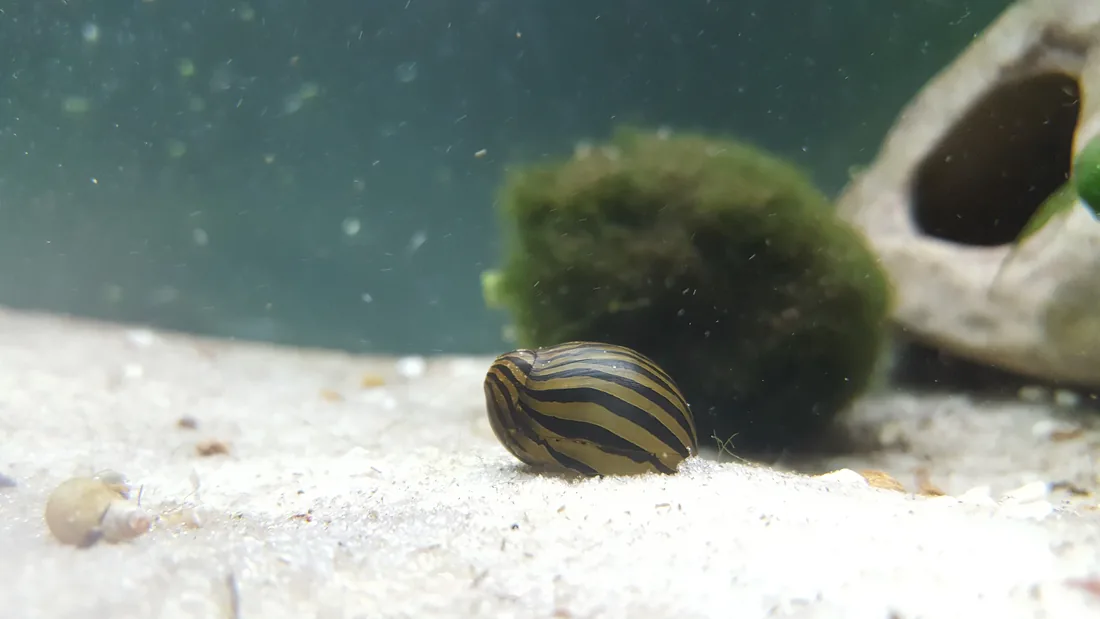
Table of contents
What a nerite snail actually is
"Nerite" is a family name, not a species. The snails sold in shops are mostly Neritina species collected from streams and river mouths in Africa, Southeast Asia and the Americas. The zebra nerite (Neritina natalensis) with its black-on-gold stripes is the most common, followed by the red racer, the black helmet, the olive nerite and the tiger nerite. They look quite different, but their aquarium behavior is nearly identical, so the care below applies to all of them.
Physically they are built for grazing. A nerite has a heavy, rounded, slightly conical shell and a strong muscular foot that clamps onto surfaces with surprising force. That grip is its defense: it can seal itself against glass or rock and be almost impossible to dislodge. It also has two thin eyestalks poking out from under the shell edge, which is usually the first thing you notice when one is cruising along the front glass.
Unlike pond snails and ramshorns, nerites do not have the anatomy to float or to glide upside down on the water surface film. They stay attached to hard surfaces: glass, driftwood, rocks, filter housings, the shells of other snails. If you see a nerite floating, it is not being cute — it has either fallen off and is drifting, or something is wrong.
Why they cannot overrun your tank
This is the single biggest reason to choose nerites over every other snail. Common aquarium snails — bladder snails, ramshorns, Malaysian trumpets — are hermaphroditic or breed freely in fresh water. Add one, feed a little too much, and within two months you have a hundred. That population explosion is the number one snail complaint in the hobby.
Nerites have a life cycle that blocks this. Adults live happily in fresh water, but their larvae — called veligers — need brackish water (roughly 1.005–1.010 specific gravity, though figures vary by species and are not well documented) to survive and settle into a shell. In a freshwater tank the eggs simply never develop. They sit there, slowly calcifying, and nothing comes out.
So a nerite's lifespan in your tank is the lifespan of the individual snail you bought, usually somewhere in the one to three year range, with good conditions pushing toward the upper end. You are not buying a colony. You are buying one worker, and when it dies you buy another. Accept that, and nerites become the most predictable cleanup crew in the hobby.
Nerites are also grazers rather than scavengers, which matters for water quality. A snail that eats leftover fish food converts it into more snail biomass and more waste. A snail that eats algae converts an unsightly film into a much smaller amount of waste. If you are already fighting algae, this is the difference you feel. Our guide to betta tank algae covers the underlying causes; a snail is a symptom manager, not a cure.
What they eat — and what they won't
Nerites are the best algae eaters most hobbyists will ever keep, but "best" comes with a specific menu:
- Green spot algae on glass and hardscape — this is their speciality. The hard, circular green dots that scrapers struggle with are exactly what a nerite rasp off.
- Diatom film — the brown dusting that appears on new tanks and on plant leaves. Nerites clear it quickly.
- Biofilm — the invisible bacterial and algal slime on every surface. This is their staple, and it is why a "spotless" tank starves them.
- Soft green algae on slow-growing plants, to a point.
What they will not do is just as important. Nerites do not eat black beard algae, they do not eat staghorn algae, they do not eat blue-green algae (cyanobacteria), and they do not meaningfully clean hair or thread algae. They also will not eat fish waste, dead plant leaves, or leftover pellets. If your problem is one of those, a snail is the wrong purchase and you will end up with a hungry snail plus the same algae.
Because nerites graze constantly, a tank can be too clean for them. Signs of underfeeding: the snail stops roaming and stays in one spot for days, the shell looks thin, or you simply never see it near food. Feed a slice of blanched zucchini, spinach, kale or cucumber weighted to the bottom, an algae wafer, or a piece of cuttlebone. Leave it 12–24 hours then remove what is left so it does not foul the water. If you want the full picture of how much food a small tank can absorb, see our feeding guide — overfeeding is what feeds algae, and algae is what feeds snails.
Setting a tank up for a nerite
Nerites tolerate a wide range of parameters, but three things are non-negotiable.
1. A lid, or at least a rim
Nerites climb. They climb glass, they climb airline tubing, they climb the filter, and eventually they climb out. A snail that dries out on the carpet overnight is the most common nerite death. Put a lid on the tank. If you run an open-top aquascape, accept that you will find a snail on the floor and check around the tank whenever one disappears.
2. Calcium and a pH that isn't acidic
A nerite's shell is calcium carbonate, and soft acidic water dissolves it. In water below roughly neutral pH with low carbonate hardness, you will see the shell go chalky, the tip wear down, and the new growth come in thin. Keep pH near neutral and carbonate hardness (KH) at a reasonable level, and supply calcium with a piece of cuttlebone tucked behind the hardscape, or a food that carries calcium. If your tap water is very soft, this is the parameter to fix before buying the snail — the same mineral issue affects shrimp and snails alike. Our water testing guide covers how to read KH and pH properly.
3. No copper, ever
Copper is lethal to invertebrates at concentrations that are harmless to fish. Many aquarium medications — especially those sold for ich, velvet and external parasites — are copper-based, and some "snail killer" products are nothing but copper. If you need to treat a fish disease in a tank that holds snails, treat in a separate hospital tank, or choose a copper-free treatment. Read the label every time; "invertebrate safe" is a claim worth verifying, not a guarantee. This applies to shrimp too, which is why choosing tank mates is really about reading medication labels as much as temperament.
Acclimating a new snail
Nerites ship badly and arrive stressed. Float the bag for 15–20 minutes to equalise temperature, then add a little tank water every ten minutes for about an hour, and finally lift the snail out rather than pouring the bag water in. Place it on a hard surface near the glass — not on the substrate, where it may bury itself and die. Expect it to sit still for a day or two before it starts roaming. That is normal.
How many snails for your tank
Nerites are not heavy bioload, but they are also not free. A rough guide: one nerite per 5 gallons (about 19 liters) of well-established tank, and no more than two in a 5-gallon tank. The limit is not waste — it is food. Two snails in a small tank with no algae will starve before they clean anything.
Only add snails to a cycled tank. Ammonia and nitrite burn a snail's foot and kill it faster than they kill fish, and a dead snail in a small tank crashes water quality quickly. If the tank is new, wait until you have read zero ammonia and zero nitrite for a couple of weeks — the cycling guide explains the timeline.
The white eggs on your driftwood
Sooner or later you will find small, oval, white capsules — each about the size of a sesame seed — stuck to the glass, the driftwood or the filter. Those are nerite eggs. They are laid individually, harden like tiny ceramic lentils, and are genuinely difficult to scrape off without scratching the surface.
Nothing will hatch. Because the larvae need brackish water, the eggs in a freshwater tank simply sit there. Some keepers find them unsightly; if a snail is laying constantly, it is usually a sign of good health and abundant food, not a problem. Scrape them with a plastic card or an old credit card, not a razor blade, and only on glass — never on acrylic or on the silicone seams.
Four problems and what they mean
- Shell turning white, chalky, or worn at the tip. Mineral problem: low calcium, low KH, or acidic pH. Fix the water, add cuttlebone. Existing damage will not heal, but new growth should look normal.
- Snail upside down on the substrate, not moving. Check the foot. A healthy snail clamps down and resists when you nudge it; a dead one falls out of the shell easily and smells. Nerites are also prone to simply falling and ending up on their back, unable to right themselves — flip it onto a hard surface.
- Snail climbing out or sitting above the water line. Something is bothering it: low oxygen, a water quality spike, or a medication. Test the water before assuming it is just exploring.
- Snail ignoring a thick algae patch. Wrong algae type. Green spot and diatoms, yes; black beard and hair algae, no. Do not buy more snails to solve it.
Nerites with bettas and other tank mates
In a betta tank, a nerite is one of the safest additions you can make. The shell protects the snail, and most bettas treat it as furniture. A minority of bettas will investigate the eyestalks or knock the snail off the glass. Watch the first few days: if the snail spends all its time clamped shut, the betta is harassing it and you should move one of them.
Avoid tank mates that are built to eat snails — loaches (especially clown and yo-yo loaches), pufferfish, and some cichlids will make short work of a nerite. Avoid anything that will out-compete it for the same algae and then leave it starving. And if you keep live plants, note that nerites will graze the biofilm on leaves without damaging the plant itself, which makes them a far better choice than a fish that "cleans" by shredding. Our live plants guide covers which species hold up best to grazing.
If you want one line to remember: nerites solve green spot algae and snail overpopulation at the same time, and they die from three things you control — a missing lid, soft acidic water, and copper. Get those three right and a nerite will quietly work the glass for years.
Related guides: How to beat algae in a betta tank · Cherry shrimp care · Safe tank mates for bettas · Best live plants for bettas · Cycling a new tank
Nerite snails — FAQ
Do nerite snails breed in a freshwater tank?
No. Nerite larvae need brackish water to develop, so eggs laid in a freshwater aquarium never hatch. You will find small white egg capsules stuck to glass, driftwood and rocks, but no baby snails appear. That is exactly why nerites are the safest cleanup snail: the population cannot explode the way ramshorn or bladder snails do.
What do nerite snails eat when there is no algae left?
They graze biofilm and algae almost constantly, so a tank that is too clean will slowly starve them. Offer blanched zucchini, spinach or kale, an algae wafer, or a piece of cuttlebone. A nerite that stops moving for days or starts to look hollow is usually underfed rather than sick.
Why is my nerite snail's shell turning white and rough?
Shell erosion in nerites is almost always a mineral problem. Soft, acidic water dissolves the shell faster than the snail can rebuild it. Raise carbonate hardness and pH toward neutral, and supply calcium through cuttlebone or a shell-bearing food. New growth at the shell edge should look smooth and dark once conditions improve.
Are nerite snails safe with bettas?
Usually yes. A nerite's shell protects it, and most bettas ignore snails completely. Some individual bettas do nip at the snail's eyestalks or flip it over out of curiosity, so watch the first few days. The bigger risks are copper-based medications, which kill snails, and a tank without a lid, because nerites climb out.