Cold House, Warm Fish: What a 62°F Bedroom Does to a Betta Tank Overnight
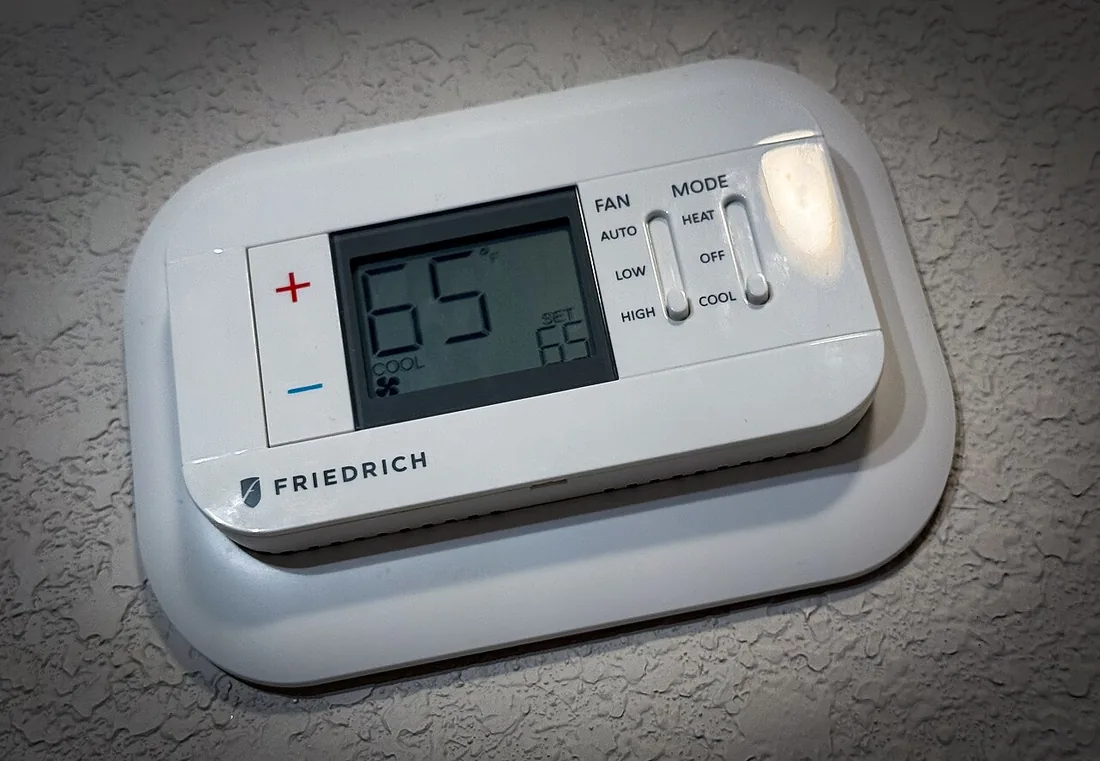
Table of contents
Why the tank doesn't follow the thermostat
The U.S. Department of Energy's standard advice is to set the thermostat back 7–10°F for eight hours a day, which is why a large share of American houses sit somewhere between 60°F and 66°F (15.5–19°C) from late evening until the heat comes back on. If you keep a betta in a bedroom or a living room, your fish lives through that setback every night, whether or not you thought about it when you bought the tank.
The reason the tank survives it at all is thermal mass. A cubic foot of water holds roughly 3,400 times as much heat as a cubic foot of air, so a tank does not snap to room temperature the way the air does. But "slower than air" is not the same as "slow." Here is the arithmetic, because it explains every number that follows.
Five US gallons of water weighs about 41.7 lb (18.9 kg). It takes 1 BTU to raise 1 lb of water by 1°F. So a 5-gallon tank gives up about 42 BTU for every 1°F it falls; a 5°F overnight drop costs the tank roughly 210 BTU of stored heat.
| Where the heat goes (uncovered 5-gallon tank at 78°F in a 62°F room) | Rough size | What changes it |
|---|---|---|
| Conduction and convection through the glass | ~50 BTU/hr | Room air movement, distance from an exterior wall |
| Evaporation from the open surface | ~40 BTU/hr at one pint per day | A lid, a fan, a dry heated room |
| Total pull on the water | ~90 BTU/hr | — |
| Water's heat capacity | 42 BTU per °F | Tank volume is the only lever |
Divide the pull by the capacity and you get roughly 2°F per hour at the start, slowing steadily as the water approaches room temperature. That is why an unheated tank left in a 62°F room is not "still warm at dawn" — it is within a couple of degrees of the room, and the fish has spent six hours in the low 60s. Evaporation matters more than most people expect: one pint of water carries about 1,000 BTU away as vapor, which is the same as cooling that whole 5-gallon tank by around 24°F if nothing were replacing the heat. A lid does not just keep dust out.
| Tank size | Water weight | BTU per 1°F | Relative overnight drop |
|---|---|---|---|
| 2.5 gal (9.5 L) | ~21 lb | ~21 | Fastest — roughly 1.6× the drop of a 10-gallon |
| 5 gal (19 L) | ~42 lb | ~42 | Baseline |
| 10 gal (38 L) | ~83 lb | ~83 | Roughly half the drop of a 5-gallon |
Less volume means more surface area per gallon, so the water trades heat with the room faster. A 2.5-gallon tank is not a smaller 10-gallon tank — it is a faster one.
What the fish actually notices
Bettas are ectotherms — their body temperature is the water temperature — so every process that keeps them alive runs at the speed of the tank. The widely agreed range for Betta splendens in captivity is 78–82°F (25.5–28°C), with 78–80°F (25.5–26.5°C) as the sweet spot where appetite, digestion and immune function all sit at their best. Different sources draw the lines a degree or two apart; the table below uses the conservative end of the consensus.
| Water temperature | What happens | What to do |
|---|---|---|
| 82–84°F (28–29°C) | Metabolism runs fast, dissolved oxygen drops | Fine short-term; do not add a second heater to "help" |
| 78–82°F (25.5–28°C) | Target band | Leave it alone |
| 76–78°F (24.5–25.5°C) | Digestion slows a little | Feed smaller portions; nudge the heater up 1°F |
| 74–76°F (23.5–24.5°C) | Clamped fins, appetite drop, less flaring | Raise 1–2°F per day, not all at once |
| 70–74°F (21–23°C) | Chronic stress, bloat and constipation risk | This is a heater problem — fix it this week |
| Below 70°F (21°C) | Danger zone; immune suppression | Stop feeding until the tank is back in range |
Two rules follow. First, a betta tolerates about ±2°F of daily movement before the drift starts costing it something; a 2°F dip in an otherwise stable 79°F tank is not an emergency. Second, recovery speed matters as much as the target: bring a cold tank back up at no more than 2°F per hour, so 72°F takes about three hours to reach 79°F. Slamming it back with a bigger heater turns a cold night into a temperature shock on top of it.
Cold also shows up before it looks like illness. A chilled betta stops eating first — the same appetite drop covered in the four causes of a betta not eating — and a chilled betta parked on the bottom matches one of the standard explanations in why bettas lie on the bottom. Check the thermometer before you check anything else.
The three-night test
Do not guess your swing, and do not trust a single glance at a stick-on strip thermometer at 4 p.m. — that reading is the warmest point of the day and tells you nothing about the 6 a.m. low. A digital thermometer with a min/max memory costs about $10–15 and answers the question in three mornings.
- Place the probe away from the heater — the opposite end of the tank, mid-depth, about 2 in (5 cm) above the substrate. A probe next to the heater measures the heater.
- Reset the min/max memory at 7 p.m. and note the current reading plus the room temperature from your thermostat app.
- Read the min and max at 7 a.m., before the heat comes back on, and write down the room's overnight low.
- Repeat for three consecutive nights. One cold snap is weather; three nights is your tank's actual pattern, and the pattern is what you are fixing.
- Subtract the min from the max. That difference is the number the rest of this guide runs on.
| Measured overnight swing | Verdict | Action |
|---|---|---|
| 2°F (1°C) or less | Normal for an on/off heater | Nothing. This is as steady as a hobby heater gets. |
| 2–4°F (1–2°C) | Acceptable, not ideal | Add a lid, move the tank off the exterior wall |
| 4–6°F (2–3°C) | Heater is losing ground at night | Step up one wattage tier, or add a controller |
| More than 6°F (3°C) | The heater is not holding its set point at all | Replace or upsize before the next cold week |
Sizing a heater for the coldest night
The hobby rule that survives scrutiny is about 5 watts per gallon to lift the water roughly 10°F above room temperature. The part people skip is the "10°F above room" condition. A 25 W heater in a 5-gallon tank is correctly sized for a 70°F room and a 78°F target — and undersized the moment the room drops to 62°F, because the gap it has to close is now 16°F, not 8°F.
| Room's overnight low | 5-gallon tank | 10-gallon tank |
|---|---|---|
| 72°F (22°C) and above | 25 W | 50 W |
| 66–71°F (19–22°C) | 50 W | 75 W |
| 60–65°F (15.5–18°C) | 50–75 W | 100 W |
| Below 60°F (15.5°C) | 75–100 W, or move the tank | 150 W |
Two equipment details decide whether that wattage actually arrives in the water. The first is preset versus adjustable. Many cheap betta heaters are sealed at a fixed 78°F with no dial at all; in a 60°F room one of those can run at full output all night and still sit at 74°F by morning, because the heater is doing everything it can and it is not enough. The second is hysteresis: ordinary on/off heaters swing ±1–2°F around their set point by design, and no amount of fiddling with the dial removes that. If you want a tighter band, the fix is an external controller with an adjustable differential down to 1°F, not a more expensive heater.
Placement is the free half of the job: mount the heater near the filter outflow so warmed water is carried across the tank, keep it fully submerged, and keep it out of the substrate and out of dense plants. A heater buried in gravel heats the gravel. The selection questions — glass versus plastic, guard versus no guard — are covered in the betta heater guide, and the winter routine is in keeping a betta warm in winter.
Hard water, soft water, and a scaled element
This is where your tap water changes the answer. In hard water areas — much of the Midwest, the Southwest and parts of Texas and Florida — calcium and magnesium carbonate plate out on the hottest surface in the tank, which is the heater element. A visible white crust 1/16 in (1.5 mm) thick measurably slows heat transfer: the heater runs longer, the tank sags further overnight, and the keeper blames a failing heater that is only insulated. Soak the element in a 1:1 white vinegar and water solution for 15–20 minutes every 2–3 months, then wipe it with a soft cloth.
In soft water areas — the Pacific Northwest, New England, much of the Southeast — scale is a non-issue and that descaling can stretch to every 4–6 months. The trade-off runs the other way: soft, low-KH water has almost no buffering, so the evaporation that cools the tank also concentrates what is dissolved in it, and pH moves faster after a top-off. And in hard water, topping off with tap water raises GH and KH permanently, because evaporation takes the water and leaves the minerals. Top off with distilled or RO water and keep tap water for actual water changes — the reasoning is in the RO water guide.
Five fixes, cheapest first
- Put a lid on it. A glass or polycarbonate lid cuts evaporation by most of its total, and evaporation is roughly 40% of the heat loss in the budget above. Expect 1–2°F of improvement for $0–25, plus less top-off water all winter.
- Move the tank. Get it at least 3 ft (1 m) from a supply register, off an exterior wall, and out of the path of a doorway or a window that gets opened. A tank sitting in front of a cold-glass window in January is being actively cooled.
- Insulate the back and one side. Half-inch foam board taped to the two faces nobody sees costs about $5 and slows conduction through the glass. It is not pretty and it works.
- Size the heater for the cold night, then add a controller. One wattage tier up from the table above, plus a controller with a 1°F differential if the swing still bothers you. This is the fix that actually holds 79°F at 5 a.m.
- Compare the two energy bills before you touch the thermostat. Heating a whole house an extra 8°F for eight hours moves roughly 0.3–0.4 therms — call it $0.40–0.60 a night at typical US gas prices. A 50 W aquarium heater running two extra hours uses 0.1 kWh, or about $0.02 at 15 cents per kWh. Keep the setback and let the heater earn its keep.
Two things people get wrong
"Bettas come from shallow water that swings ten degrees a day, so a nightly swing is natural." Shallow water does warm and cool quickly, and wild Betta splendens do live in the slow, shallow parts of the Mekong basin. But that fact is usually deployed backwards. A fish that evolved to survive fluctuation is not a fish that benefits from it — the same shallow water is a large part of why wild bettas are seasonal animals with short lives compared with tank-raised ones. The claim also drifts: the "lives in a puddle that dries up" story belongs to annual killifish, not to bettas. Replace it with: hold 78–80°F, accept ±2°F of drift, and treat anything past 4°F as a piece of equipment to fix.
"Turn the heater dial up two degrees before bed so the morning reading comes out right." A heater's dial sets a target, not a buffer. On an adjustable heater, raising the set point to 82°F does not make the tank "ahead" of the cold — it makes 82°F the new target, so the water is at 82°F at dawn and drifts to 83–84°F when the room warms up at 7 a.m., which is the wrong direction. And on a preset 78°F heater there is no dial to turn. Replace it with: set the heater once for 79°F, size it so it can hold that in your coldest room, and let the thermostat do its job.
What this guide does not cover
This article is about the cold half of the year and the overnight window specifically. It does not cover summer overheating or chillers, and it does not cover power outages — a 12-hour outage in a 62°F house is a different problem with a different answer (battery air pump, wrap the tank, do not feed).
It is also not a diagnostic tool. If your tank reads 78–80°F on three consecutive mornings and the fish is still clamped, listing or refusing food, temperature is not the cause — work through the disease and water-quality guides instead. And a betta that has been below 70°F for days, shows a swollen belly and has stopped passing waste is a cold-stress bloat case, not a fish waiting to bounce back.
Related guides: Does a betta need a heater? · Keeping a betta warm in winter · Seasonal betta care · Betta not eating
Cold rooms and betta tanks — FAQ
Can a betta survive one cold night?
Usually yes. A single night at 70–72°F is uncomfortable rather than fatal for a healthy adult, and the fish typically returns to normal within a day once the water is back at 78–80°F. What does lasting damage is repetition: a tank that drops 5°F every night for weeks keeps the immune system suppressed, and it is a common reason a betta stops eating in January.
How fast does a 5-gallon betta tank cool overnight?
Roughly 2°F per hour at the start, slowing as the water approaches room temperature. Five gallons holds about 42 BTU per °F, and an uncovered tank in a 62°F room loses heat at something like 90 BTU per hour through the glass and by evaporation. In practice an unheated 5-gallon tank is within a couple of degrees of room temperature by morning.
Is 76°F too cold for a betta?
It is below the ideal band rather than immediately dangerous. At 76°F digestion slows and appetite usually drops, and most keepers see clamped fins before anything worse. Move the tank up 1–2°F per day until it holds 78–80°F, and do not feed heavily while it is cool, because food moves through the gut more slowly.
Should I turn the tank heater up at night?
No. A heater's dial is a target, not a reserve, so raising it overnight just moves the target and leaves you overshooting when the room warms in the morning. Set it once at 79°F and size it so it can hold that in your coldest room; if the swing is still more than 4°F, the heater is undersized or the element is scaled.
Do I still need a heater in a 10-gallon tank if the room stays at 70°F?
Yes. A 10-gallon tank in a 70°F room sits at about 70°F — 8°F below the target band and inside the range where chronic stress and bloat risk climb. The larger volume only means it drifts there more slowly, not that it stops drifting.