Aquarium Test Strips vs Liquid Test Kits: The Ammonia Pad That Isn't There
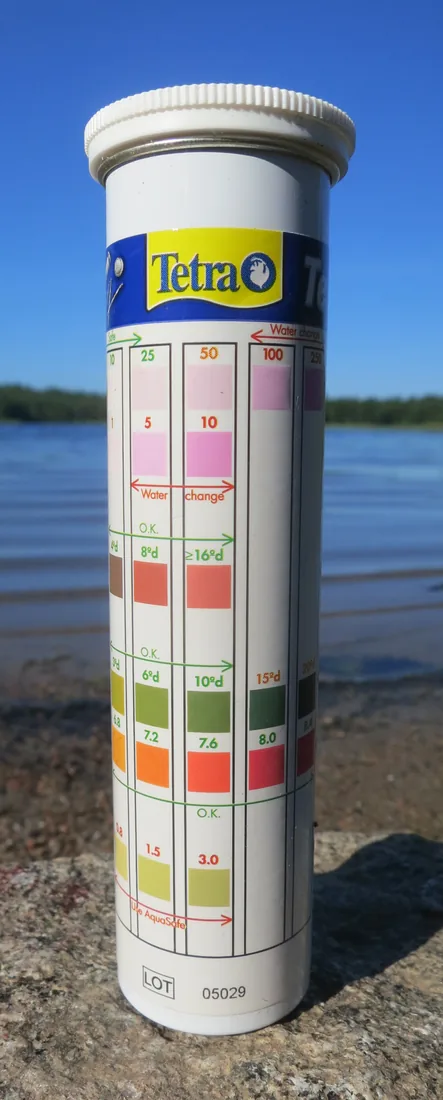
Table of contents
- What a 6-in-1 strip actually measures
- The pad that isn't there: ammonia
- Block size: the number sits between two colors
- Where a strip is genuinely good enough
- The one-sample double test, in 10 minutes
- Storage is half the accuracy
- Three things almost everyone gets wrong
- The cost math nobody does
- Hard water, soft water, and chloramine
- What to actually own
- What this article does not cover
- Test strips vs liquid kits — FAQ
What a 6-in-1 strip actually measures
A dip strip is a plastic stick with five or six reagent pads glued along one end. Dip for one second, hold it level, wait the time printed on the tube — 60 seconds for the common 6-in-1 — and compare each pad to the chart on the label. The whole job takes a minute, which is why people reach for them.
The six pads are chlorine, nitrite, nitrate, general hardness (GH), alkalinity (KH) and pH. That list sounds like everything a freshwater tank needs, and that is where the confusion starts. Two of those pads, GH and KH, are the coarsest on the strip, and the most dangerous parameter in a new tank is missing entirely. The chlorine pad also reads total chlorine — free and combined together — which answers "did my conditioner work" but not "is my supply chloraminated."
The pad that isn't there: ammonia
Ammonia kills fish in 24 hours, and the standard 6-in-1 does not test it. Neither does the common 5-in-1. The ammonia pad is sold as its own tube, because that chemistry does not survive dry storage as gracefully as the others do.
This bites hardest in the exact situation where beginners buy their first kit — a brand-new tank. For the first four to six weeks a tank runs an ammonia source with no bacteria mature enough to process it. Ammonia climbs, then nitrite climbs behind it. If your only test reads nitrate, nitrite, GH, KH, pH and chlorine, you are blind through the entire lethal stretch and fully sighted only once it is over.
There is a sneakier version. On a chloraminated supply — most large US municipal systems, including much of California, Texas, Florida and the Midwest — a conditioner splits chloramine into chlorine and ammonia. The chlorine pad then reads zero, which looks like success, while free ammonia sits in the bucket. A zero chlorine reading is not evidence that the new water is ammonia-free. That trap is covered in chloramine in tap water.
Block size: the number sits between two colors
A strip does not give you a number. It gives you the nearest block on a printed ladder, and the ladder is coarse by design because a pad the size of a grain of rice cannot resolve fine gradations. Look at the tube in the photo: the nitrate column steps 25, 50, 100, 250 ppm. A tank at 30 and a tank at 45 land on the same two colors, and you cannot tell which side of the water-change line you are on.
Fine for "is nitrate creeping up?" Useless for "do I change 25% or 50% today?"
| Parameter | Strip resolution (typical) | Liquid kit resolution | Where the difference bites |
|---|---|---|---|
| Ammonia | Not on a 6-in-1; separate ammonia pads start at 0.5 ppm | First step off zero is 0.25 ppm | Cycling, and any dead-fish or overfeed event |
| Nitrite | 0, then 0.5, 1, 5 ppm | 0, 0.25, 0.5, 1, 2, 5 ppm | A tank at 0.25 ppm reads zero on a strip and is still toxic |
| Nitrate | 0, 25, 50, 100, 250 ppm | 0, 5, 10, 20, 40, 80, 160 ppm | Sizing a water change; judging plant uptake |
| GH / KH | Wide blocks, about ±1–2 dGH at best | 1 drop = 1 dGH or 1 dKH | Shrimp, and any tank where KH is holding pH |
| pH | 0.2–0.4 steps | 0.2 low range, 0.2 high range | Fine on a hard buffered tank, noisy on a soft one |
Two thresholds decide what you do in the next hour rather than next week. Ammonia or nitrite at 0.25 ppm or above means a water change today. Nitrate at 40 ppm or above means the weekly change is overdue; below 20 ppm is a comfortable place to sit. On a strip, the first threshold is invisible.
Where a strip is genuinely good enough
None of this makes strips a bad purchase. It makes them a bad only purchase. They are the right tool when the question is about direction rather than precision:
- Weekly trend on a cycled tank. Nitrate on the same block three weeks running means your routine is working. One block up two weeks in a row means it is not — and you can act on that without knowing whether the number is 30 or 45.
- Fast triage across several tanks. Four tanks, one minute each, and you know which one deserves the drops and the bucket.
- Your own tap after a seasonal switch. Utilities change source water; a strip shows the GH block moved before your shrimp do.
What they share: a wrong-but-directional answer costs nothing, because the next step is the same either way. Once a reading decides a dose, a medication, or whether a fish goes in the tank, switch tools.
The one-sample double test, in 10 minutes
Strips and drops disagree often enough that people assume one is broken. Usually they were never compared on the same water at the same temperature at the same time. Do this once per parameter and you will know exactly how far to trust your own tube.
- Pull one sample. About 4 oz (120 mL) of tank water into a clean glass — one sample for both tests, not two dips into the tank.
- Let it sit 5 minutes to reach room temperature. Both chemistries develop color at different rates at 78 °F (26 °C) and 68 °F (20 °C), so a warm strip against a cold drop test compares temperatures, not methods.
- Run the strip first. One-second dip, do not shake the excess water off, hold level the full 60 seconds, read in daylight at a window. Not under a warm LED, not in a dim bathroom — light is the largest single source of "my strip is wrong."
- Run the drops on the same glass immediately. Fill the vial to the line, count drops at eye level, and follow the shake times. The standard nitrate bottle two wants 30 seconds of hard shaking plus a firm tap to loosen the crystals, or it reads falsely low.
- Compare and log both numbers with the date. Within one block means the strip is good for trend use. Two blocks or more means trust the drops and check the strip's use-by date before blaming the method. After three paired tests you will usually see a consistent bias — always half a block high on pH, always one low on nitrate — and you can correct for it.
Storage is half the accuracy
Every strip tube prints roughly the same four lines: cap it tightly, store at room temperature, keep it from moisture, do not remove the drying agent. Those lines are the difference between a strip that reads and a strip that guesses, and almost nobody follows them. The enemy is humidity, not time — a tube opened once a week still takes a small breath of room air each time, and the desiccant pellet inside a 25-strip tube is sized for months of that, not years.
- Write the open date on the tube. Treat six months as the working life even when the printed use-by date is a year out.
- Never store strips in a bathroom, a laundry room, or the cabinet above the stove. The three most humid spots in a US home.
- Do not refrigerate them. A cold tube fogs the moment you open it, which is condensation delivered straight to the pads.
- Look at the pads before dipping. A nitrate pad already showing pink, or a mottled pH pad, has taken on moisture and is finished. Replace the tube.
Liquid reagents age differently. Sealed, a good kit keeps about three years. Opened, the state of the bottles matters more than the date: the nitrate reagent separates and crystallizes, which is why the hard-shake instruction exists, and a bottle that has changed color or grown sediment should be replaced rather than trusted.
Three things almost everyone gets wrong
"Six tests in one dip means I'm covered." The usual version is a beginner cycling a tank with a 6-in-1 and no ammonia test — the one parameter that matters in weeks one through six is the one the strip skips. The other half is that GH and KH, the pads shrimp and plant keepers lean on, are the two coarsest on the strip. A 6-in-1 is a screening tool, not a panel.
"Keep strips in the fridge so they last longer." The opposite is true. Refrigeration barely slows the chemistry but guarantees condensation every time the tube comes out. Cool and dry is the instruction; cold and damp is what a fridge delivers.
"Nitrite reads zero, so the cycle is finished." The nitrite pad's first step above zero is 0.5 ppm, so a tank sitting at 0.25 ppm — enough to damage a betta's gills — reads as a clean zero. The finish line is ammonia at zero and nitrite at zero on drops, three days running, with nitrate visibly rising. The cycling guide walks that sequence day by day.
The cost math nobody does
Strips get bought because they look cheaper. Per test, they are not.
| 6-in-1 strip tube (25 count) | Liquid freshwater master kit | |
|---|---|---|
| US price | about $11–15 | about $35–40 |
| Tests per purchase | 25 dips | roughly 800 tests |
| Cost per dip or test | about $0.45–0.60 | about $0.04–0.05 |
| Parameters covered | 6, without ammonia | 5, including ammonia and both pH ranges |
| Useful life once opened | about 6 months | about 3 years sealed |
So the honest conclusion is not "throw the strips away." It is that strips carry a real premium of roughly eight to ten times per reading, and that premium buys speed and no glassware. Fine for a weekly glance at an established tank, a bad deal for the six weeks you spend cycling one.
Hard water, soft water, and chloramine
The same strip behaves differently depending on what comes out of your tap, and this is where most "my strip is broken" reports begin.
- Soft water — much of New England and the Pacific Northwest, plus any house with a softener: the GH pad's first blocks cover 0 to about 50 ppm, so 1 dGH and 2.5 dGH land inside the same square. For neocaridina shrimp, or any tank where KH is holding pH, use drop kits — the GH and KH guide has the drop-by-drop method and target ranges.
- Softeners specifically: the GH pad will read near zero because it measures calcium and magnesium, which the softener traded for sodium. That is a true statement about hardness and a silent one about the sodium, which is the part that matters for fish. Softened water is a separate decision from soft water.
- Hard water — the Midwest, the Southwest, and a lot of Texas and Florida well water: the GH pad tops out and the nitrate pad stops at 250 ppm. Both are fixable the same way: mix the sample half and half with distilled water, read it, double the result.
- Chloramine: the chlorine pad cannot separate free from combined chlorine, and after conditioning it reads zero either way. If your utility uses chloramine, run one ammonia test on the new water before it goes in, once, to see whether your conditioner is binding the ammonia it releases.
On a hard, buffered tank a single pH strip reading means something, because KH is holding the number steady. On a soft tank pH can move several tenths in a day, and a single reading means very little — that is a buffering problem, not a testing problem, and it is covered in why aquarium pH drops.
What to actually own
- Cycling a tank, weeks 1–6: liquid ammonia, nitrite and nitrate, daily until both toxins read zero for three days running, then every other day for a week. A strip adds nothing here.
- One established tank, one betta: ammonia and nitrite drops on the shelf, plus a strip tube for the weekly nitrate and pH glance. Cheapest combination with no gap in it.
- Four tanks or more: strips for the weekly sweep, drops for whichever tank trips a pad. This is where the strip's speed earns its premium.
- Shrimp or a planted tank: add GH and KH drop kits. Do not run shrimp on strip hardness readings; the block width is wider than the range the animals tolerate.
- Under $20 to spend: liquid ammonia first, strips second. Ammonia is the one that kills overnight, and no 6-in-1 measures it.
For a betta specifically: weekly nitrate and pH, ammonia whenever the fish behaves oddly, and a full liquid panel whenever a number looks bad enough to act on. The fuller routine, including target values for each parameter, is in how to test betta tank water.
What this article does not cover
This compares two colorimetric methods and nothing else. It does not cover digital pH probes, TDS pens or inline monitors, each of which needs its own calibration routine and fails in its own way. It does not cover marine or reef kits, where alkalinity and calcium are read by titration and the numbers do not translate to freshwater. It does not cover dissolved oxygen or CO2, which neither strips nor standard liquid kits measure well. And it is not a diagnostic guide: a reading tells you what the water is doing, not what is wrong with the fish.
Related guides: Testing your betta's water · Chloramine in tap water · GH and KH, explained · Why aquarium pH drops
Test strips vs liquid kits — FAQ
Do aquarium test strips test for ammonia?
Most multi-parameter strips do not. The common 6-in-1 reads chlorine, nitrite, nitrate, general hardness, alkalinity and pH, and the 5-in-1 versions drop the chlorine pad rather than adding ammonia. Separate ammonia strips exist, and their lowest step is usually 0.5 ppm. If you are cycling a tank, buy a liquid ammonia test alongside the strips.
Are test strips accurate enough for a betta tank?
For a weekly trend on an already cycled tank, yes. For ammonia, for nitrite near zero, and for any reading you are about to act on, no. The nitrite ladder starts at 0.5 ppm and the nitrate ladder jumps from 25 to 50 ppm, so the two numbers that usually decide a water change are the two it cannot resolve.
Why do my test strips and liquid kit disagree?
Usually because they were not run on the same sample under the same conditions. Temperature changes how fast the pads develop, the strip has to be read at its stated time in daylight rather than under warm indoor light, and the nitrate reagent needs 30 seconds of hard shaking or it reads low. Run both on one glass at room temperature; if they still differ by two blocks, check the tube's open date.
How long do test strips last after opening?
Treat six months as the working life even when the printed use-by date is later. Moisture, not time, is what ruins them, and every opening lets in a little room air. Keep the cap tight, keep the desiccant inside, store the tube in a dry drawer at room temperature, and throw it out if the pads already show color before they have been dipped.