Betta Tail Types: Halfmoon, Crowntail, Plakat & More
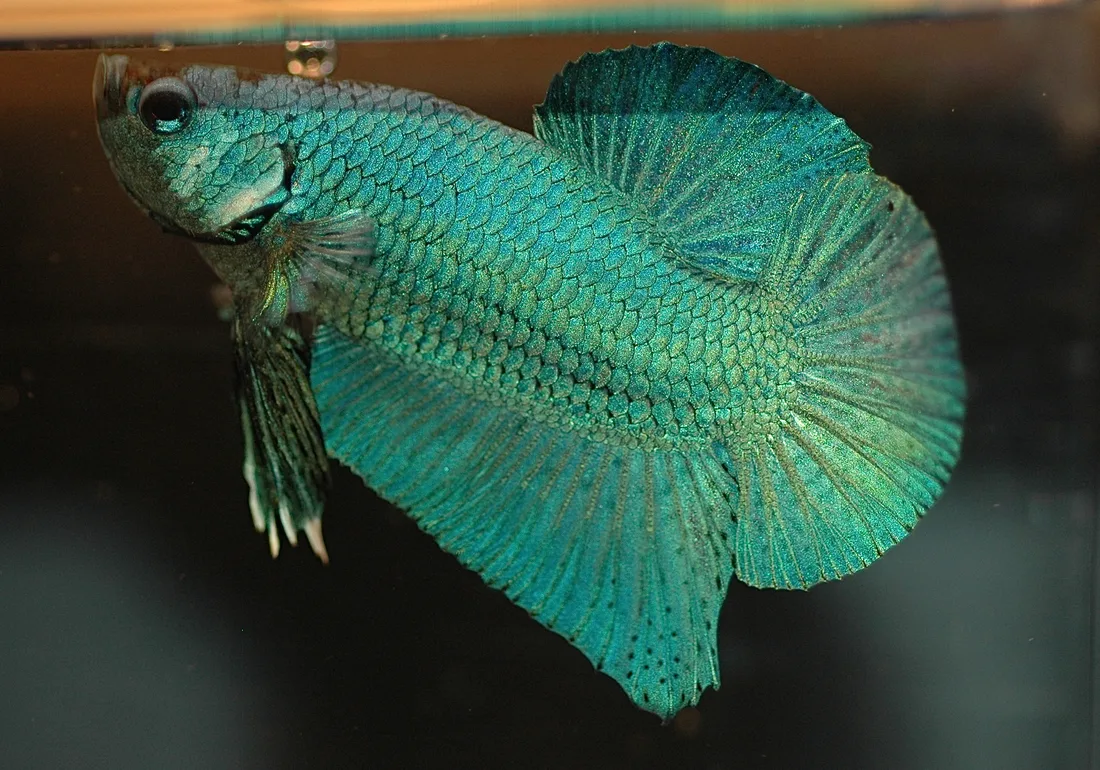
Table of contents
A quick note: wild vs. fancy tails
Before you pick a betta based on looks, it helps to understand where those looks come from. The fish you buy at the pet store is Betta splendens — the same species that lives wild in the rice paddies, canals and floodplains of Thailand, Cambodia and Vietnam. In the wild, that fish has a short, rounded tail that lets it dart and turn quickly in dense, shallow water.
Every flashy Halfmoon or Rose Tail you see in a shop was produced by decades of selective breeding for bigger, more elaborate fins. Those beautiful tails come at a cost: they weigh the fish down. A heavy-tailed betta swims more slowly, tires more easily, and drags fins that are easy to tear on rough decor. That trade-off is the single most important thing to understand when you are choosing between tail types — and it is the reason this guide recommends different care for different fins.
The tail types you'll actually see
Pet shops and breeders label bettas by tail shape. Here are the ones you are most likely to meet, roughly from easiest to most demanding to keep.
Plakat
The Plakat (from the Thai word for "fighting fish") has a short, sturdy tail and body fins that look almost like a wild betta. Because the fins are small, a Plakat is the fastest and most agile of the fancy types, and its fins almost never tear. It is the most robust, the least fussy, and the best choice for a small tank or a first-time owner who wants a healthy, active fish. Male Plakats are still just as colorful and just as likely to flare as a Halfmoon — they just carry their fins more efficiently.
Veil Tail
The Veil Tail is the classic betta most people picture, and it is the commonest type in pet stores. Its tail flows downward into a long, elegant, slightly asymmetrical shape that may trail behind the fish. A Veil Tail is still a fairly heavy fin, but it is less extreme than a Halfmoon or Rose Tail, and Veil Tails tend to be hardy and adaptable. They are a reasonable middle ground: prettier than a Plakat, more forgiving than a Halfmoon.
Delta & Super Delta
A Delta has a fan-shaped tail that spreads to roughly 120 degrees when flared — a triangle like the Greek letter delta. A Super Delta opens wider, closer to 150–160 degrees. These sit between the Veil Tail and the Halfmoon in size, and they strike a nice balance of show and manageability. If you want an impressive tail without committing to the most demanding care, a Super Delta is a good pick.
Halfmoon
The Halfmoon is the showpiece: when fully flared, its tail opens a full 180 degrees into a smooth half-circle, and its dorsal and anal fins are equally dramatic. Halfmoons are heavier than Deltas and are bred hard for that huge, clean arc. They need a roomier tank than a Plakat or Veil Tail, gentle water flow, and more attention because a big, delicate tail is easy to tear and slow to regrow.
Crowntail
A Crowntail looks spiky: the webbing between the fin rays stops short of the ray tips, so the fins end in a jagged, crown-like edge. Crowntails are striking and reasonably common, and the spiky silhouette is arguably slightly tougher than a solid Halfmoon web because there is less webbing to tear. Still, the rays are exposed and can be damaged, so the same roomy, gentle-flow advice applies.
Double Tail
A Double Tail is bred so the tail is split into two lobes, like two shorter fans side by side. This makes the fish look unusual, but the split tail is structurally weaker and some breeders note it can be more prone to issues. Double Tails are not as common and are mainly for people who specifically love the look; they are not the easiest betta to keep.
Rose Tail & Feather Tail
These are the extreme end of breeding: a Rose Tail has an over-folded, ruffled Halfmoon-like tail that looks like a rose, and a Feather Tail has extra webbing that frays into feathery strands. They are breathtaking and fragile. The heavy, folded fins are the hardest to maintain, the most likely to tear, and the most prone to fin rot if water quality slips. Unless you are experienced and committed to extra care, these are best admired in photos rather than brought home.
How tail size changes your care routine
The bigger the tail, the more your care routine has to adapt:
- Tank size. A Plakat or small Veil Tail can do fine in a properly cycled 5-gallon tank. A Halfmoon, Rose Tail or Feather Tail will be much happier in 10 gallons or more, because a heavy fin needs open swimming room and cannot be crammed into a tiny bowl. Check the betta tank size guide for minimums.
- Water flow. Big tails get buffeted by strong current. Use a gentle sponge filter or a low-flow adjustable filter, and point the outflow at a wall or soften it with decor. A Plakat can handle a bit more flow; a Rose Tail cannot.
- Decor. Sharp gravel, plastic plants with rough edges, and any ornament with a tight gap are hazards for a flowing tail. Smooth, rounded decor and soft live plants are safer — see the best live plants for bettas for gentle options.
- Water quality. Long, heavy fins are magnets for bacterial and fungal fin rot if ammonia or nitrite spikes. Keep up with water changes and testing — the water-quality testing routine is non-negotiable for big-tail bettas.
- Stress. A heavy tail makes a betta tire faster when flaring at its reflection or a tank mate. Give big-tail bettas a calm tank and plenty of resting spots near the surface, like a broad-leaf plant.
None of this means a Halfmoon is "unhealthy" by default. It means the setup has to compensate for the fin. Give a heavy tail the room, the gentle flow and the clean water it needs, and it lives just as long as a Plakat.
Which tail type is best for a beginner
If this is your first betta, or if you only have room for a 5-gallon tank, the honest answer is a Plakat, or failing that a Veil Tail. Both are sturdy, active, and forgiving of small mistakes. You still get the bright colors and the personality — you just do not have to babysit a fragile fin.
If you have a larger tank (10+ gallons), you already have experience, and you love the look, a Halfmoon or Super Delta is a reasonable step up. Save the Rose Tail and Feather Tail for later; they are the highest-maintenance fish in the hobby. Whatever you pick, buy from a shop that keeps bettas in individual, clean containers, and inspect the fins at the store: tight, intact fins and clear eyes are better signs than a dramatic but damaged tail.
Color and tail type are two separate things
Buyers often confuse color and tail type, but they are bred independently. Color refers to pigment and pattern — solid blue, solid red, "koi" (mottled orange-white-black), "marble," "galaxy," and so on. Tail type is purely the shape and size of the fins. You can find a blue Veil Tail and a blue Halfmoon, a koi Plakat and a koi Crowntail. When you are shopping, decide the tail type first (based on how much care you can give), then pick your favorite color within that type. That way you do not talk yourself into a fragile Rose Tail just because you loved the pattern.
Preventing fin tears on big-tail bettas
Even with the right setup, big fins sometimes take damage. Here is how to keep tears from becoming infections:
- Remove the hazard. Inspect every decoration and the filter intake for sharp edges, tight gaps, or rough gravel. Plastic plants are the usual culprit — swap them for live or silk plants with soft leaves.
- Soft the flow. Reduce current until the tail drifts, not flaps, when the betta hovers.
- Keep water clean. A small tear heals on its own in good water. Ammonia or nitrite turns a minor tear into fin rot, so test and change water on schedule.
- Do not add "fixers" by reflex. If fins do not heal within a week or the edge turns white and frayed, that is fin rot and needs treatment. Many pet remedies are overused, so follow the dosing carefully rather than dosing "just in case."
Choose the tail type that matches your setup and patience, give it a calm, roomy, clean home, and your betta will reward you with years of bright color and personality. The tail is a trade-off you pick at the store — the care that keeps it healthy is on you afterward.
Related guides: How much space a betta needs · How to set up a betta tank · How to breed bettas · How long bettas live · Signs of a happy betta
Betta tail types — FAQ
Which betta tail type is easiest to keep?
A Plakat or a Veil Tail is the easiest to keep, especially in a smaller tank or for a first-time owner. Short, sturdy tails make swimming easier and are far less likely to tear on decorations. Big-tail types like Halfmoons and Rose Tails are gorgeous but need a roomier tank, gentle water flow, and more careful maintenance to keep their fins healthy.
What is the difference between a Halfmoon and a Crowntail betta?
A Halfmoon betta has a large tail that spreads a full 180 degrees, forming a smooth half-circle. A Crowntail has webbing that does not reach the tips of the fin rays, so its fins look spiky or ragged at the edges. Both are fancy, heavy tails that need a bigger tank and gentler flow than a Plakat.
Do big betta tails cause health problems?
A heavy tail does not automatically shorten a betta's life, but it makes swimming harder and leaves the fins more exposed to tears, fin rot, and snagging on decorations. With clean water, a roomy tank, smooth decor and a gentle filter, a Halfmoon or Crowntail can live a full, normal lifespan.
Is a Plakat betta the closest to a wild betta?
Yes. A Plakat has a short, rounded tail that closely resembles the wild Betta splendens found in Thailand and Cambodia. Because the tail is small and sturdy, a Plakat is a faster, more agile swimmer and is generally the most robust and easiest-to-care-for of all the fancy tail types.