How to Breed Betta Fish: Step-by-Step for Beginners
Table of contents
Before you start: 3 honest checks
Breeding bettas is one of the most rewarding projects in the hobby — but it also kills fish when rushed. Do these three checks first, and be honest with yourself about each one:
- Age and health. A male should be 4–6 months old and a female 3–4 months. Younger fish rarely spawn and older ones produce weak spawns. Both fish must be active, eating eagerly, and free of clamped fins, spots, or bloating — a sick parent is a guaranteed weak batch of fry.
- Space for the babies. A single spawn can produce 100–300 fry. By week three they each need growing space, and males will eventually need to be separated or rehomed. If you cannot take on that, wait — spawning is the easy part; raising fry is the commitment.
- Your patience. Conditioning takes 1–2 weeks, spawning another few days, and fry need daily feeding and water changes for months. It is a slow, step-by-step process — which is exactly how this guide is written.
If your fish are healthy and your tanks are in order (you can double-check sizes with our betta tank size guide), you are ready for the next step.
Conditioning the pair (week 1–2)
Conditioning simply means getting both fish into peak breeding shape. Keep the male and female in separate tanks — never together — and feed them the best food you can for 1–2 weeks:
- Feed live or frozen high-protein food twice a day: bloodworms, brine shrimp, daphnia, or mosquito larvae. Pellets alone are usually not enough to trigger spawning condition.
- Keep the water warm and clean at 78–80°F, with regular small water changes so water quality is excellent.
- Give the female a hiding spot. A female being "courted" by sight of a male should have plants or a leaf to retreat behind, which lowers stress and makes her more willing to spawn later.
- Slow the male's feeding two days before spawning — a male ready to breed is more interested in building a nest than eating, and a full belly makes spawning clumsy.
Feeding details and portion sizes for live foods are covered in our betta feeding guide. If a fish stops eating or looks stressed during conditioning, pause and treat the cause — a stressed fish should never be introduced to a breeding tank.
Setting up the breeding tank
A breeding tank is deliberately simple. The goal is shallow, warm, calm water with one place for the male to build his nest. Here is the checklist:
| Item | Recommendation | Why it matters |
|---|---|---|
| Tank size | 5–10 gallons | Enough room for the pair and later the growing fry. |
| Water level | 4–5 inches (10–12 cm) | Fry need to reach the surface quickly to gulp air as they develop. |
| Temperature | 80–82°F (27–28°C) | Speeds egg development and hatching; see our heater guide to size it. |
| Filter | Sponge filter on low, or none | Strong flow destroys bubble nests and scatters fry. |
| Lid | Yes, always | Bettas, especially males, jump — and fry jump too. |
| Nest anchor | Floating plant, or a clean leaf | The male builds his nest under a floating surface. Easy floating plants like water sprite work well. |
An Indian almond (catappa) leaf is optional but popular: it releases tannins that calm both fish and help egg fungus resistance. The full tank-building steps otherwise follow the same logic as our tank setup guide — just shallower and warmer than a display tank.
Introducing the pair and the bubble nest
This is the part beginners rush, and it is the most common place a spawn fails. The male must build a bubble nest before the female is released:
- Put the male in the breeding tank first and let him settle for 24 hours.
- Add the female in a clear jar or breeder box floating inside the tank, so the pair can see each other without touching. This sight (and hormones in the water) is what triggers the male to start building a nest.
- Wait for the bubble nest. Most ready males build one within 1–3 days — a cluster of small bubbles under the floating plant. Some males skip a big nest and still spawn; that is fine.
- Release the female only when the nest is there (or the male shows intense courting display). A ready female may show vertical "stripe" bars and lower her head — classic breeding posture.
- Watch closely for 10–20 minutes. Some chasing and nipping is normal courtship. If the male relentlessly attacks the female or she hides constantly, separate them and try again in a day or two.
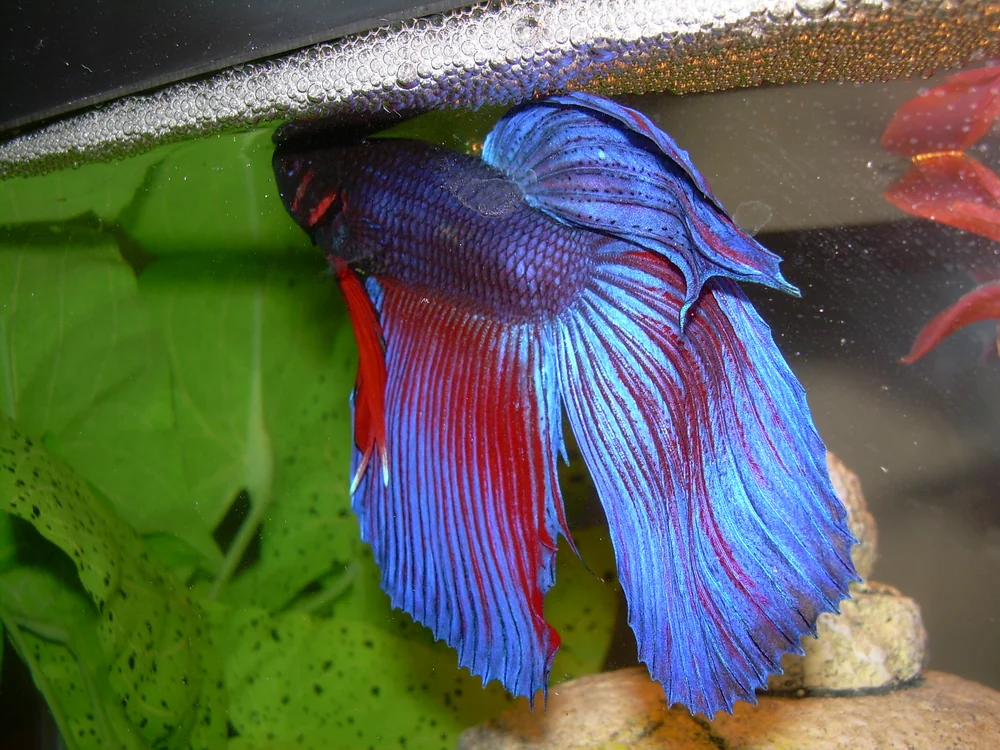
When spawning begins, the male wraps his body around the female in a "nuptial embrace," fertilizing eggs as she releases them, then carries each egg to the nest. The embrace repeats for hours. Bettas that are compatible spawn readily; if nothing happens in 2–3 days, take the female out, let both rest a week, and try once more before moving on.
Eggs and hatching: what the male is doing
Once spawning finishes, remove the female immediately. The male now guards the nest and will chase her away — she may also eat eggs if she stays. From this point:
- The male tends the eggs, retrieving any that fall and keeping the nest together. Let him do his job; do not disturb the tank.
- Eggs hatch in about 24–36 hours at 80–82°F.
- Newly hatched fry hang in the nest for 2–3 more days, absorbing their yolk sac. Do not feed them yet.
- When the fry start swimming horizontally and leave the nest ("free-swimming"), the male's job is done — remove him now, or he may eat the moving fry.
During these days, do not clean the tank, do not net the fry, and keep the room warm so the water never dips. Patience here saves more fry than any product.
Raising the fry: food, water, and timing
Fry care is a daily routine for about 8 weeks. It is not hard, but it is non-negotiable:
- First food (days 0–4 after free-swimming): infusoria or a liquid fry food, offered in tiny amounts twice a day. Fry mouths are too small for anything else. Infusoria is simply cultured beforehand by soaking a pinch of hay, lettuce, or banana peel in a jar of tank water for a few days.
- Second food (from around day 4–7): baby brine shrimp (hatch your own — it takes ~24 hours) or microworms. This is when fry grow fastest.
- Transition (weeks 2–8): gradually add finely crushed high-quality flakes or powder, while keeping live food as the base. Feeding choices are the same logic as our adult feeding guide, just ground finer.
- Water: keep the temperature steady at 80°F and do small daily or every-other-day changes of about 20–25% with conditioned water of the same temperature. Fry produce waste quickly and die fast in dirty water.
- Never overfeed. Uneaten food poisons the tank within hours. When in doubt, feed less — fry survive hunger far better than ammonia.
As fry grow, lower the water level gradually (they need to reach the surface for air) and, from about week 6–8, separate the males into individual cups once you can tell them apart — young males will start fighting exactly the way adult bettas do.
Common breeding mistakes
- Breeding fish that are too young or too old. The classic cause of no spawn or tiny weak batches.
- Skipping conditioning. A male that hasn't been fed well rarely builds a nest; a female that isn't ready rejects or fights the male.
- Releasing the female before a nest exists. This turns courtship into a chase — separate them and wait for the nest.
- Water too cold or too deep. Cold slows everything; deep water makes it hard for fry to reach the surface and gulp air.
- Leaving the male in too long. Once fry swim free, the male becomes a predator. Remove him the day they start moving around the tank.
- Feeding fry food that is too big. Fry simply can't eat standard flakes or crushed pellets for the first week — infusoria and baby brine shrimp are the non-negotiable starters.
Betta breeding FAQ
How long does it take betta fish to breed?
After about 1–2 weeks of conditioning, a healthy pair usually spawns within 1–3 days of being introduced. The eggs hatch in about 24–36 hours, and the fry become free-swimming roughly 3–5 days after spawning.
Do betta fish need a special tank to breed?
Not a special filter, but the setup matters: a 5–10 gallon tank with the water level lowered to about 4–5 inches, a heater holding 80–82°F, a lid (bettas jump), and a floating plant or leaf where the male can anchor his bubble nest.
Why did my betta fish not breed?
The usual causes are water that is too cold, fish that are too young or not conditioned, no bubble nest yet, or a female that is not ready. Wait for the male to build a nest and the female to show readiness before expecting spawning.
What do baby betta fish eat?
For the first 3–4 days after they become free-swimming, fry need infusoria or a liquid fry food. Once they are a few days old, switch to baby brine shrimp or microworms, then gradually to finely crushed flakes.
When should I remove the male betta from the breeding tank?
Remove the female right after spawning, while the male guards the eggs. Remove the male too once the fry are free-swimming (about 3–5 days after spawning) — at that point he may start eating the fry.
Related guides: Right tank size · Plants for cover · Water changes · Why bettas can't live together