Indian Almond Leaves for Bettas: Real Dosage, Tannins, and the pH Myth
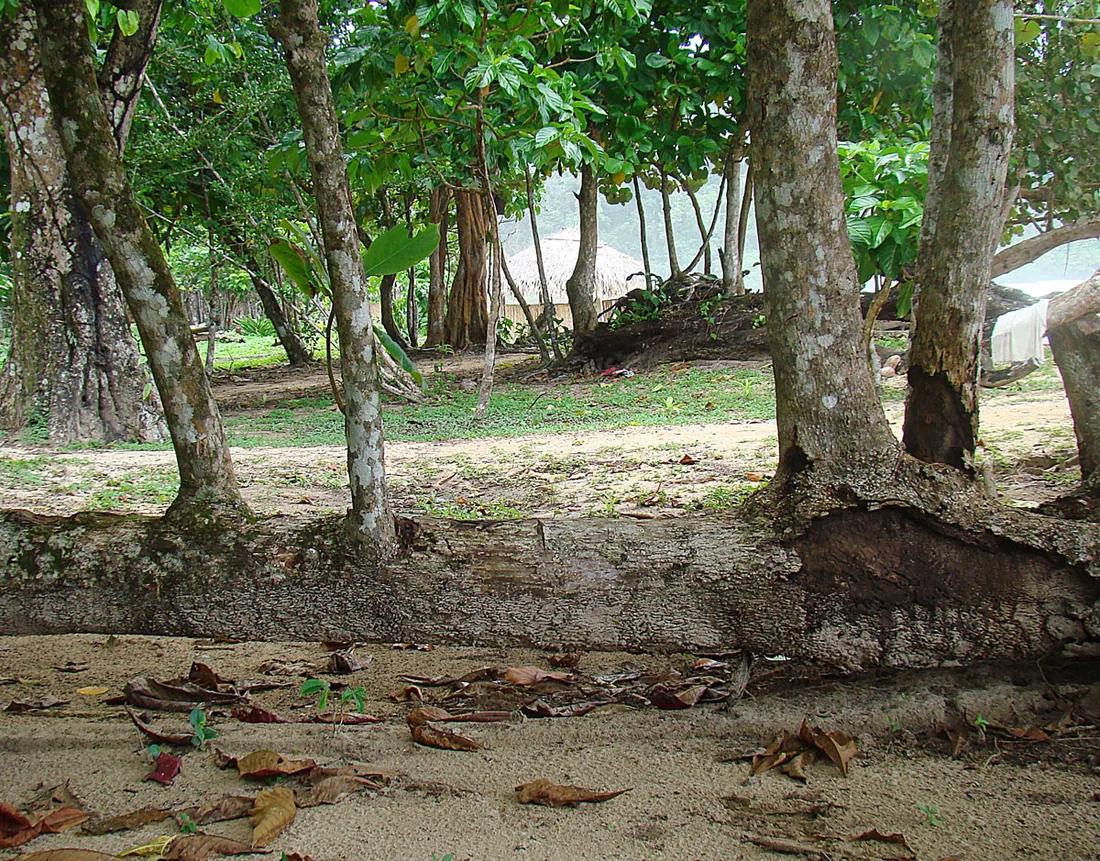
Table of contents
What is actually in the leaf
Indian almond is Terminalia catappa, the sea almond or tropical almond — a beach tree planted across the tropics for shade, with leathery leaves 6 to 10 inches (15 to 25 cm) long that go red before they fall and dry to a brittle brown. In the aquarium trade the dried leaves are sold as Indian almond leaves, IAL, or ketapang, the Indonesian name. The hobby picked them up because the shallow, leaf-littered water bettas come from in Thailand and Cambodia is brown in exactly this way.
What the leaf releases into water is a mixture of tannins (both condensed and hydrolyzable types), humic and fulvic acids, and flavonoids. The tannins are what stain the water: they absorb blue and violet light and let yellow and brown through, which is why a tank with leaves looks like weak iced tea rather than cloudy. The acids are what give the water its slight bite, and they are weak — gallic acid, one of the main tannin building blocks, has a pKa around 4.4.
One number gets left out of most guides: leaf-to-leaf variation. A big freshly fallen leaf holds several times the tannin of a small thin one, and drying method changes how fast it comes out. That is why a dose is a starting range rather than a prescription, and why the color of the water is a decent gauge for "how much leaf is in here" but a useless gauge for "what my pH will be tomorrow."
Dose by tank size, and how to prep the leaf
Start at one leaf per 5 gallons. There is no benefit to stacking leaves past the point where the water looks like cola — the extra leaf mass just becomes decaying organic matter in a few weeks.
| Tank volume | Large dried leaves | Tint you should expect |
|---|---|---|
| 2.5 gal (9.5 L) | ½ leaf | Light amber by day 3 |
| 5 gal (19 L) | 1 leaf | Weak iced tea within 24 hours if steeped first |
| 10 gal (38 L) | 1–2 leaves | Clear amber to medium brown |
| 20 gal (76 L) | 2–3 leaves | Medium brown |
| 29 gal and up (110 L+) | 3–4 leaves | Medium brown; more leaves buys darkness, not chemistry |
The order that gets tannin into the water fastest, without dumping dust and grit into the tank:
- Rinse the leaf under the tap for about 10 seconds. This removes grit and dust, nothing more — it is not sterilization.
- Optional but worth it: put the leaf in a mug, pour 1 cup (240 mL) of boiling water over it, and steep 10 to 15 minutes. The water turns dark amber and most of the easy tannin is already out.
- Let it cool to within 2°F (1°C) of tank temperature — a mug of boiling water poured into a 5-gallon tank is a real temperature spike for a betta — then pour the liquid and the leaf in together.
- Skip the boiling and it still works, just slower: expect visible tint at 3 to 5 days instead of overnight.
- Replace every 2 to 4 weeks. Pull the leaf once it tears with no resistance or starts shedding fragments into the gravel; from that point it is adding oxygen demand, not tannin.
What a leaf really does to pH
This is the part that decides whether the leaf is a decoration or a chemistry experiment, and it is decided by your KH, not by the leaf.
KH is carbonate hardness — the bicarbonate in the water, measured in degrees. One degree of KH is about 17.9 mg/L of calcium carbonate equivalent, and bicarbonate is a base: any acid you add reacts with it first, before free hydrogen ions are left over to move the pH. A leaf's total acidity is small compared with a well-buffered tank. So in water with 4 to 8 dKH, the acid is consumed almost as fast as it appears and the pH reading does not budge outside your test kit's resolution.
| Your KH | Expected pH effect, 1 leaf per 5 gal | What to watch |
|---|---|---|
| 0–1 dKH | Can fall 0.5 to 1.0 or more over 3–5 days | Test pH daily for the first 3 days; if it drops under 6.0, change 25% of the water |
| 2–3 dKH | 0.1 to 0.3 fall | Weekly pH; watch for a slow slide across several weeks |
| 4–6 dKH | 0.1 or less — below what a hobby kit resolves | Nothing. You get color, not chemistry |
| 7 dKH and up | None measurable | Same. Leaves are not a pH tool in this water |
Those ranges come from the carbonate chemistry, not from a lab bench on your particular leaf, so treat them as an expectation and confirm with your own kit. If you have never measured KH, a drop test takes five minutes and it is the single number that predicts whether leaves will do anything chemical in your tank — the GH and KH guide walks through the test and the RO mixing ratios.
Three claims that do not hold
"Indian almond leaves cure fin rot and bacterial infections." This is the claim that sells the most leaves and it is the one that most often delays real treatment. There is genuine laboratory work behind part of it: extracts of T. catappa leaf have shown antibacterial activity against fish pathogens including Aeromonas hydrophila in culture. But those tests use concentrated extract on a petri dish. A whole leaf dropped into 5 gallons delivers an unknown and far lower concentration, nobody has published a dose-response for that, and the water is not sterile. Fin rot is a water-quality and bacterial problem: ammonia and nitrite first, then a real antibiotic if the fin margin is actively receding with redness at the base. The fin rot and color-loss guide covers that sequence. Keep the leaf if you like the look — just do not let it be the plan.
"One leaf drops your pH to 6.0 and recreates blackwater." Only in water that is already unbuffered. The pH table above is the whole story: in the hard tap water that most US utilities deliver, a leaf changes the color of the tank and nothing about the reading. Readers who want an actual pH shift need to start from low-KH water — usually RO mixed with tap — and then the leaf is a fine way to bring it down gently instead of with a pH-down bottle.
"Leaves dechlorinate tap water." No. Tannins do react with chlorine, but at no rate you can rely on, and they do nothing about chloramine, which is what most US systems now use. Chloramine is ammonia plus chlorine; even a product that breaks the chlorine bond leaves the ammonia behind. Dose a conditioner that explicitly binds chloramine every time, and see the chloramine guide for why 24 hours of standing does not help.
A fourth, quieter one: tannins do not soften water. They are acids, not ion exchangers — GH does not fall because the water turned brown.
Hard water, soft water, and chloramine
Hard water — much of the Midwest and Southwest, GH around 10 dKH and up, KH commonly 6 to 10. Here the leaf is decorative. Buy it for the look and the cover, not for the pH. Two useful side effects: the tint cuts light transmission a little, which quietly helps in a low-tech planted tank, and you can be generous with leaves without any risk of a pH crash. Do not expect it to fix hard water for a betta either — that takes dilution with RO water, which the GH/KH article covers.
Soft water — New England, the Pacific Northwest, much of the Southeast, KH often 0 to 2. This is where leaves actually work, and where they need supervision. Low KH means the pH was already unstable before you added anything; the leaf's acid tips it further. Test pH daily for the first three days the first time you use leaves. A slow drift from 7.0 to 6.4 across a week is acceptable for a betta, which comes from water in the 6.0 to 7.0 range. A jump of half a point in a day is not, and the usual cause is too many leaves in too little unbuffered water.
Chloramine, everywhere. Dechlorinate before the leaf goes in, not after. One practical detail: color and turbidity are standard interferences in colorimetric water tests, and tea-brown tank water is both. If you want to confirm your tap water is chloraminated, test a clear glass of tap water straight from the faucet rather than a sample from the tinted tank.
What it looks like in a betta tank
The tint itself. One leaf in 5 gallons for two weeks gives a light amber that most people like. Two leaves gives a brown that some keepers find handsome and others find too dark to see the fish against. If the water reads as cola rather than iced tea, you have gone past the useful dose.
Cover and behavior. Wild Betta splendens live in shallow, warm, slow water with leaf litter on the bottom, so brown water is closer to the fish's natural conditions than clear water is. Be careful with the next step, though: there is no controlled study measuring stress hormones in bettas given Indian almond leaves, so "it calms them" is a reasonable inference from habitat, not a measured effect. What the leaf does do concretely is give a shy fish something to sit under, and cover is something any nervous betta will use.
Breeding setups. Ketapang water is standard practice in Southeast Asian betta breeding, where pairs are conditioned and spawned in leaf-tinted water. If you are following the breeding guide, a leaf in the spawning tank is a normal addition, not an exotic one.
Tankmates. Cherry shrimp will graze the biofilm that forms on a softening leaf, and nerite snails ignore it entirely. Plants are unaffected apart from slightly less light. The combination to avoid is leaves plus aquarium salt, because the salt is what hurts shrimp, snails, and plants — not the leaf. The aquarium salt guide explains the three cases where salt does more harm than good.
When not to use it
Leaves are cheap and harmless in the right tank, which is exactly why they get used in the wrong ones. Skip them, or pull them, in these situations:
- The fish is actually sick. Dropsy, popeye, velvet, and Columnaris need a diagnosis and usually medication. Brown water is not a treatment, and waiting a week to see whether the leaf works is a week of disease progression.
- You are running an antibiotic course. Pull the leaf for the duration. Dissolved organics and heavy staining make dose-reading and color-based observation unreliable, and organic matter can adsorb some medications.
- Your KH is near zero and you already have pH problems. Adding an acid to unbuffered water is how a stable-but-low pH becomes a swinging one.
- You are stacking botanicals. Leaf plus alder cones plus a blackwater extract in a 5-gallon tank is a common way to get a pH crash and an oxygen dip at the same time.
- Ammonia or nitrite is above zero. Fix the cycle first; a decaying leaf is additional organic load, and the cycle is the thing that has to keep up with it.
Scope, plainly: this article covers how to dose and read Indian almond leaves in a betta tank. It does not diagnose disease, does not tell you how to treat an infection, and does not replace a dechlorinator, a test kit, or a water change. If a fish is gasping at the surface after you add leaves, that is an oxygen problem — add surface movement, do not add another leaf.
Related guides: GH and KH explained · Chloramine in tap water · Fin rot and color loss · Aquarium salt for bettas
Indian almond leaves — FAQ
How many Indian almond leaves should I use per gallon?
One large dried leaf (6 to 8 inches, 15 to 20 cm) per 5 US gallons, which is 19 liters. A 10-gallon tank takes 1 to 2 leaves, a 20-gallon 2 to 3, and a 2.5-gallon tank half a leaf. Going above roughly one leaf per 5 gallons mostly adds decaying plant matter, not more usable tannin.
Do Indian almond leaves lower the pH of a betta tank?
Only if the water has almost no carbonate buffer. Tannins are weak acids and the bicarbonate in your water neutralizes them first, so at 4 dKH or more a leaf changes the color and leaves the pH where it was. Below 2 dKH the pH can slide by half a point or more over three to five days. Test KH before you expect any pH change.
Can I leave the leaf in the tank until it disappears?
No. A leaf releases most of its tannin in the first 7 to 10 days, then becomes decaying biomass that consumes oxygen and adds to the organic load. Replace it every 2 to 4 weeks, and pull it sooner once it tears with no resistance. In a tank under 5 gallons, a leaf left to rot can move ammonia.
Do Indian almond leaves cure fin rot?
They are not a cure and should not be the plan. Extract of the leaf shows antibacterial activity against fish pathogens in laboratory tests, but a whole leaf in a tank delivers an unknown and much lower concentration, and no dose-response has been published. Fin rot is driven by water quality and bacteria, so fix ammonia and nitrite first and use an antibiotic if the fin margin is actively receding.
Are Indian almond leaves safe for shrimp, snails, and plants?
Yes at the doses above. Cherry shrimp graze the biofilm that forms on a softening leaf, and snails are unaffected. Plants are fine too, since the tint only reduces light slightly. The one combination to avoid is leaves plus aquarium salt in the same tank, because the salt is what harms shrimp and plants, not the leaf.