Softened Water in a Fish Tank: Why 0 GH Doesn't Mean Soft Water
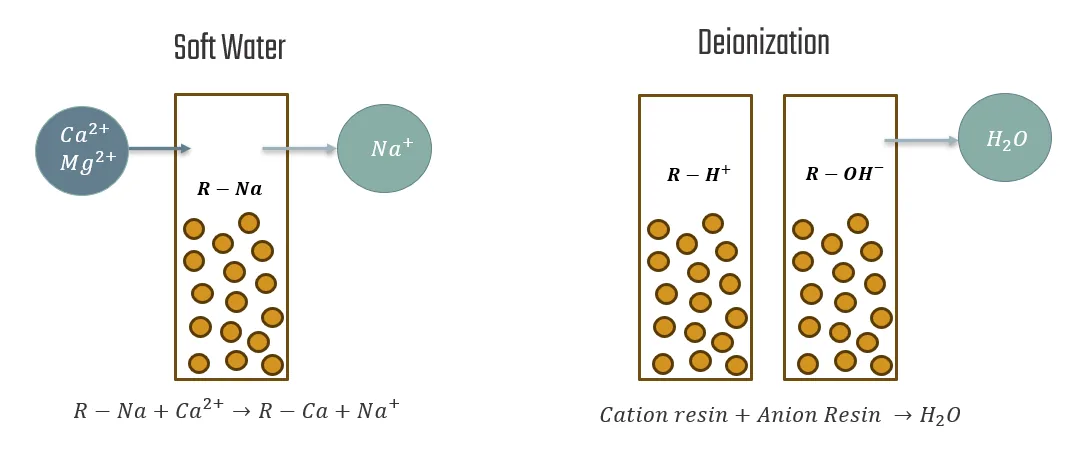
Table of contents
- What a softener actually does: it trades, it does not remove
- The two-number test that identifies your water
- How much sodium ends up in the tank
- The real problem is the calcium that left
- Two softener claims to ignore
- What to use instead: a five-step decision path
- Rebuilding GH when the softener is your only tap
- Hard water, soft water, and when this page does not apply
- Softened water in an aquarium — FAQ
What a softener actually does: it trades, it does not remove
A softener is a tank of synthetic resin beads charged with sodium. The resin prefers doubly charged calcium and magnesium ions to singly charged sodium ones, so it grabs the hardness minerals and releases sodium in their place. A brine rinse later washes the calcium and magnesium to the drain and reloads the beads. Nothing else in the water is filtered out at all. That single mechanism explains everything a fish keeper runs into:
- General hardness (GH) drops to 0–1 dGH. The calcium and magnesium are gone, so a drop kit reads almost nothing.
- Carbonate hardness (KH) does not change. Bicarbonate is an anion, and the resin only trades positive ions. A tank fed on softened water keeps the same KH — and roughly the same pH — as the raw tap water.
- TDS does not fall. Two sodium ions replace each calcium ion, so dissolved solids stay level or creep up. A TDS meter cannot confirm a softener is working, and an ultrasonic humidifier on softened water still throws white dust — now sodium salts instead of calcium ones.
- Nothing else is removed. Nitrate, phosphate, silicate, chlorine and chloramine are untouched. If your utility chloraminates, softened water still needs a conditioner; see why chloramine will not gas off.
Here is the wrinkle that trips people up. A plumber and a fish keeper both say "soft water" and do not always mean the same thing. To a plumber, soft means no scale-forming calcium. To the hobby, "soft water" usually implies low KH too — the slightly acidic water rasboras and wild-type bettas come from. A softener delivers the first and not the second, and that gap is where most of the confusion lives. If the GH/KH distinction itself is fuzzy, the GH and KH explainer covers what each number controls.
The two-number test that identifies your water
Before changing anything, find out which of three waters you are holding: raw hard tap, softened tap, or RO. Two tests on the same sample separate them cleanly. Run a GH drop kit and a TDS meter on water from the tap you plan to use, then compare against your utility's published hardness. That report comes in mg/L as calcium carbonate or in grains per gallon, and the conversion is fixed:
| Unit | Equivalent | What a GH kit reads |
|---|---|---|
| 1 gpg (grain per gallon) | 17.1 mg/L as CaCO3 | ≈ 0.96 dGH |
| 1 dGH (German degree) | 17.85 mg/L as CaCO3 | 1 drop on most kits |
| 100 mg/L as CaCO3 | 5.85 gpg | ≈ 5.6 dGH |
Then read the pair together:
- GH 0–1 dGH, TDS unchanged from the raw tap — softened. The minerals were swapped for sodium.
- GH 0–1 dGH, TDS down 90% or more — reverse osmosis. Everything went, including the buffer, which is a different problem with a different fix; the RO blending guide covers that case.
- GH matches the utility report, TDS normal — this tap bypasses the softener. Keep using it.
One practical shortcut before you spend anything: outdoor hose bibs are usually plumbed upstream of the softener, because nobody wants to regenerate a house's worth of resin on lawn watering, and many kitchens have a hard-water line to the cold side of the sink. Neither is guaranteed, so test both with the GH kit rather than trusting the plumbing. Never sample the hot side: hot water has sat in a tank or coil, picks up more dissolved metal, and in older homes can carry lead from solder. Cold, always, and let it run for 30 seconds first.
How much sodium ends up in the tank
The sodium figure is not a guess — it is stoichiometry. Ion exchange swaps one calcium ion (charge +2) for two sodium ions (charge +1 apiece), so the sodium added is set entirely by how much hardness was removed:
Sodium added (mg/L) ≈ hardness removed (gpg) × 7.9, or equivalently hardness removed (mg/L as CaCO3) × 0.46. Both factors come from the same arithmetic and the published figures land within a narrow band of 7.5 to 8.1, so 7.9 is a safe working number.
| Hardness removed | Sodium added | Per 8 oz glass | Typical of |
|---|---|---|---|
| 5 gpg (≈ 4.8 dGH) | 39 mg/L | 9 mg | Moderately hard municipal water |
| 10 gpg (≈ 9.6 dGH) | 79 mg/L | 19 mg | Hard water, much of the Midwest |
| 15 gpg (≈ 14.4 dGH) | 118 mg/L | 28 mg | Hard to very hard |
| 20 gpg (≈ 19.2 dGH) | 158 mg/L | 37 mg | Very hard, Southwest and limestone country |
| 25 gpg (≈ 24 dGH) | 197 mg/L | 47 mg | Private wells over limestone |
| 30 gpg (≈ 28.8 dGH) | 236 mg/L | 56 mg | Extreme; usually a well, not a utility |
For scale, one level teaspoon of aquarium salt stirred into 5 gallons (19 L) puts roughly 120 mg/L of sodium in the tank — about the same as softened water from a 15 gpg source. So softened water sits in the same order of magnitude as a light salt treatment, not a brine bath. Two EPA numbers are worth keeping straight, because they get quoted interchangeably: 30 to 60 mg/L is the taste advisory, the level above which sensitive people notice saltiness, while 20 mg/L is what the agency recommends for households on a very low sodium diet of 500 mg a day. A 15 gpg softener clears both. That is why such households often keep one unsoftened cold tap for drinking. Two caveats: the table is the sodium added by softening, so add whatever was already in the source water from your utility's report; and the brine in the salt tank never enters your water, so a distinctly salty taste means the unit is passing brine and needs service.
The real problem is the calcium that left
It is tempting to treat sodium as the villain, and the number above is worth knowing. But for a freshwater tank, sodium at 40 to 160 mg/L sits well below the concentration that harms fish — freshwater species regulate against far more. What actually goes wrong on softened water is the absence of calcium and magnesium:
- Plants stall. Calcium and magnesium are macronutrients, not trace elements. A 0 dGH tank is a tank on a calcium-free diet, and the usual symptom is new growth that comes in pale, twisted or pinholed while old leaves stay fine.
- Shrimp and snails cannot build. Neocaridina shrimp and nerite snails draw calcium from the water for shells and exoskeletons. On straight softened water, colonies tend to show failed molts — shrimp stuck half out of a split shell — and thin, chalky shells within a couple of months. The cherry shrimp guide treats stable hardness as the single most important parameter.
- The pH you wanted never arrives. With KH unchanged at 7 or 8 dKH, the tank still buffers to pH 7.8–8.2 no matter what the GH reads.
One consolation worth stating plainly: a tank dosed with a GH booster at every water change ends up in almost the same place whether the base water was softened tap or RO. Softened water is not a dead end — it is an unfinished product.
Two softener claims to ignore
"Softened water is basically RO water — it's been treated, so it's purified." This one causes real damage because it leads people to skip dechlorination and to expect a lower pH. Softening removes exactly one thing: the calcium and magnesium. It leaves nitrate, phosphate, silicate, sulfate, chloride and chloramine in place, and it does not lower TDS. RO removes 90 to 99% of all of it. A tank run on softened water without conditioner is still a tank being filled with chloramine, and the ammonia that chloramine leaves behind still shows up on a test — a bound-ammonia reading of 0.25 to 0.5 ppm that looks like a filter failure and is not.
"Soften the water and you can keep soft-water fish at the right pH." The reasoning sounds right: less hardness, softer water, lower pH. It fails because pH in a cycled tank is governed by KH, and KH is the one thing the resin cannot touch. You can watch it happen — GH 0, KH 8, pH 8.1, and it stays there. Getting to pH 6.8 means removing or neutralizing carbonate, which means RO or rainwater as a base, or a deliberate acid-and-buffer routine; the mechanism is in what actually moves aquarium pH. If you bought the softener for this reason, it will still do its plumbing job — it just will not do the aquarium job you had in mind.
A third, smaller one, since it comes up in every softener thread: "the softener is adding salt to my tank." It adds sodium ions, which is not the same thing as sodium chloride, and it adds no chloride of its own — disinfection still has to be handled separately.
What to use instead: a five-step decision path
- Look for an unsoftened cold tap first. Outdoor bib, cold side of the kitchen sink, or a line teed off before the unit. Test it with a GH kit. If GH matches your utility's number, you are done — use that tap for the tank and keep the softener for the laundry.
- No unsoftened tap? Decide what the tank needs. A fish-only tank with no live plants and no shrimp can run on softened water indefinitely, provided you dechlorinate for chloramine and accept the pH your KH gives you. A planted, shrimp or snail tank cannot.
- For plants or invertebrates, put the minerals back. Either dose a commercial GH booster at every water change, or mix your own from gypsum and Epsom salt using the table below.
- Top off evaporation with RO or distilled water, never softened tap. Evaporation leaves the sodium behind, so topping off with softened water concentrates it season by season. This matters most in heating season, when a dry house can pull a half-inch off a 10-gallon tank in a week.
- If you want low pH, plan for RO. A softener will not get you there. Blend RO with your hard tap to a target GH, then adjust KH separately if the pH still needs to come down.
If sodium itself is the concern — a household on a sodium-restricted diet, generally not the fish — the softener can be regenerated with potassium chloride instead. The resin then releases potassium, which is actually a plant nutrient. It changes nothing about the aquarium problem: GH is still 0.
Rebuilding GH when the softener is your only tap
Two dry salts do the job and cost very little: calcium sulfate (gypsum) for the calcium, magnesium sulfate (Epsom salt) for the magnesium. A 3:1 split by hardness contribution roughly matches what most tap water carries and what plants expect. The amounts below are calculated from equivalent weights for 5 US gallons (19 L), assuming the Epsom salt is the ordinary heptahydrate sold in drugstores (MgSO4·7H2O) — a bag labeled anhydrous needs about 0.8× the Epsom figure, not the same number. Confirm the result with a GH kit once, then trust the scale rather than the arithmetic.
| Target GH | Gypsum (CaSO4·2H2O) | Epsom salt (MgSO4·7H2O) |
|---|---|---|
| +1 dGH | 0.45 g | 0.35 g |
| +2 dGH | 0.9 g | 0.7 g |
| +3 dGH | 1.3 g | 1.0 g |
| +5 dGH | 2.2 g | 1.7 g |
Two notes on execution. A 0.1 g jeweler's scale costs less than a bottle of booster and removes the guesswork; a level quarter teaspoon of gypsum is roughly 1.2 g, too coarse a unit for a 5-gallon tank. And dissolve the salts in a jug of warm water first — gypsum dissolves slowly and otherwise lands on the substrate as visible white grains. For a betta, 5–8 dGH is comfortable and there is no need to chase a number; for neocaridina shrimp, 4–8 dGH with calcium actually present is the working range, and week-to-week stability matters more than the middle of it. The betta care guide covers the other parameters in the same units.
Hard water, soft water, and when this page does not apply
Which branch you are on depends on the water coming into the house, not on what the softener does to it:
- Hard or very hard source (over 7 gpg — much of the Midwest, Texas, Arizona, Nevada and California's interior). This is the page's main case. GH reads 0, KH is still high, and plants and shrimp pay for it. Rebuild GH, top off with RO, and do not expect pH to move.
- Moderately hard source (3.5–7 gpg). Some households soften here and some do not. If yours does, the sodium added is under 60 mg/L and the calcium deficit is the only real issue; a booster at water changes is enough.
- Already-soft municipal water (under 3.5 gpg — the Pacific Northwest, New England, much of the Southeast). There is probably no softener and this page mostly does not apply. The exception is diagnostic: if soft-source tap reads 0 dGH, something else is treating it — a whole-house filter with a softening cartridge, or a building-wide system in an apartment.
What this page does not cover: salt-free conditioners and magnetic descalers, which do not remove hardness at all and therefore change nothing about GH, KH or sodium; well water with dissolved iron, where the resin fouls; whole-house RO; and the medical question of dietary sodium, which belongs to a doctor rather than an aquarium guide. If you are fighting an algae or disease problem and hoping the softener explains it, it probably does not — start with light, feeding and flow.
Related guides: GH and KH explained · RO water and the blend ratio · Chloramine in US tap water · Cherry shrimp care
Softened water in an aquarium — FAQ
Can I use softened water in a fish tank?
You can, and it is not an emergency — the sodium it adds is far below the level that harms freshwater fish. But it is a poor everyday base because it carries almost no calcium or magnesium, which plants and molting shrimp need, and because its alkalinity is unchanged, so it will not give you the lower pH people usually buy a softener for. Use an unsoftened cold tap if you have one, or rebuild the minerals at water-change time.
Does a water softener remove chlorine or chloramine?
No. Ion-exchange resin swaps positively charged calcium and magnesium ions for sodium. Chlorine and chloramine are not hardness minerals and pass through unchanged, so softened water still needs a dechlorinator that handles chloramine. Only a softener with a carbon pre-filter, or an RO unit, changes that.
Will softened water lower my aquarium pH?
Barely at all. pH is held up by carbonate and bicarbonate alkalinity, measured as KH, and the resin does not touch it — KH reads the same before and after the softener. A tank on softened water with 8 dKH still sits near pH 8 even though GH reads 0. To actually lower pH you have to remove or neutralize KH, which means RO water, rainwater, or a deliberate acid plan.
How do I know if my tap water is softened?
Test GH and TDS on the same sample. Softened water reads 0 to 1 dGH while TDS barely moves, because the minerals were swapped rather than removed. RO water also reads 0 dGH but drops TDS by 90 percent or more. If GH is 0 and TDS is unchanged, a softener is responsible.
Is softened water safe for shrimp and snails?
Not as a sole water source. Neocaridina shrimp and nerite snails build shells and exoskeletons from calcium in the water, and softened water has essentially none left. Colonies on straight softened water tend to show failed molts and thin, pale shells within a couple of months. Aim for 4 to 8 dGH with calcium and magnesium present, and top off evaporation with RO or distilled water rather than softened tap.