Why Is My Betta Turning White? Marble Gene, Stress, or Columnaris
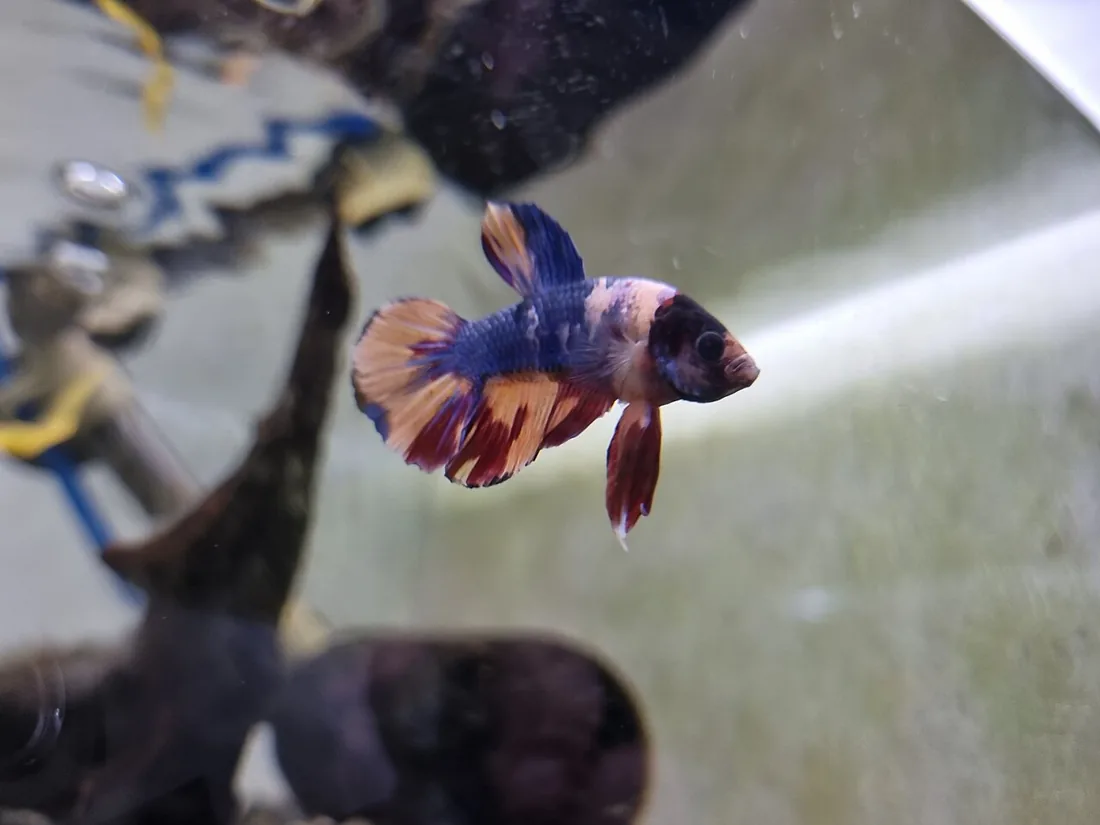
Table of contents
- The four kinds of white, side by side
- Type 1: stress pallor and the 20-minute test
- Type 2: the marble gene
- Type 3: Columnaris, the "false fungus"
- Type 4: velvet
- The 10-minute triage
- What actually brings color back
- Three claims that do not hold
- Check the water, hard or soft
- What this does not cover
- Betta turning white — FAQ
The four kinds of white, side by side
Betta color is not paint. It is a layer of pigment cells — melanophores for black-brown, erythrophores for red, xanthophores for yellow, and reflective iridophores and leucophores for blue-green sheen and white. A fish can change color three ways: by shrinking those cells within minutes, by permanently switching them on and off as it grows, or by having them buried under an infection. Three mechanisms, four common answers.
| What you see | How fast it moves | Fish behavior | Most likely cause |
|---|---|---|---|
| Whole body fades evenly, fins included, no sharp border | Minutes to hours, and it can go back and forth | Normal appetite, normal swimming | Stress pallor |
| Crisp-edged white or cream patches next to full-strength blue or red | Weeks to months, never reverses | Completely normal | Marble / koi pigment |
| Fuzzy or cottony white-gray patch, often a saddle across the back | 24–72 hours, spreads fast | Clamped fins, lethargy, off food | Columnaris |
| Fine gold or rust "dust" that looks white under a light | Days; fish flashes and scrapes | Clamped, scraping, breathing hard | Velvet (Oodinium) |
The useful question is not what color is it but does the white have a clean edge, and how long did it take. Pigment has a sharp boundary. An infection has a soft, eroded boundary that eats into the color beside it. Stress sits in between: the whole fish goes dull at once, with no boundary at all.
Type 1: stress pallor and the 20-minute test
When a betta is frightened, cold, or sitting in irritating water, it contracts its pigment cells. Color drains toward the center of each cell and the fish looks washed out, sometimes nearly silver. The mechanism runs both ways — a pale fish can darken again just as fast.
Common triggers, roughly in order of how often they explain a sudden pale betta:
- Cold water. Anything sustained below 76°F (24.5°C) dulls a betta; a fish at 72°F (22°C) looks ill even when nothing is wrong.
- A new tank or a recent move. Bagging, shipping, and netting cause pallor that lasts hours, not weeks.
- Ammonia or nitrite. At 0.25 ppm ammonia the fish may already be pale with red or dark gills.
- Sudden light or movement. A shadow passing the tank buys a few minutes of washed-out color.
The 20-minute test: turn on the room light, stand still for two minutes so the fish settles, then offer one pellet. If the color deepens while the fish is eating — within about 20 minutes — the white was pallor, and the pigment system is intact. That result is worth more than any forum diagnosis, because it rules out both infection and pigment change in one step.
Pallor is a readout, not a disease: the color returns when the trigger goes away, and that is the whole treatment. What pallor does not do is stay for weeks in good water. A betta that has been uniformly pale for a month at 79°F (26°C) with 0 ammonia is not "just stressed" — look at parasites and internal infection next.
Type 2: the marble gene
Some bettas carry a mobile genetic element — a jumping gene — that can switch pigment production on or off in patches of skin as the fish grows. Breeders selected for it deliberately, and the result is the koi and marbled patterns now sold in every big-box store: blue and red with cream or white blocks, often with a black marbling edge.
Because the element keeps moving, the pattern keeps changing. A koi betta that is 80% red at four months can be 80% white at twelve months, and the fish is not sick in either state. There is no treatment, no supplement, and no product that brings the red back, because nothing was damaged — the cells that would make red were switched off. Heavily marbled and dragon-scale lines can also develop scales that grow over the eye, which is a separate breeding issue and not something you can reverse either.
The 8-week rule. If a white patch has kept the same shape for 8 weeks while the fish eats normally, swims level, and shows no fuzz or erosion, treat it as pigment and stop looking for a cure. Two things still deserve attention in a marbled fish: a patch that suddenly develops a fuzzy texture, and a fish that goes pale everywhere rather than in blocks.
One caveat on color-enhancing foods: they supply carotenoids that deposit in cells the fish already has, so they can deepen red in a fish that is already red. They cannot create white, and they cannot switch a marble patch back on.
Type 3: Columnaris, the "false fungus"
This is the one to take seriously, and it is the one most often misread. Flavobacterium columnare is a bacterium that grows in flat, cottony, white-to-gray colonies — visually almost identical to a water mold. On a betta it usually appears as a saddle-shaped patch across the back in front of the dorsal fin, or as white crusting on the lips, the gill covers, or the edges of the fins. Under the fuzz the tissue is being eaten away, so the border of the patch looks soft or frayed rather than crisp.
Speed is the diagnostic. At 82°F (28°C) a small spot can become a body-wide lesion in 24–72 hours, and the fish usually stops eating and clamps its fins before the patch is large. Warm water increases how fast this bacterium spreads, which is exactly why the standard "raise the heat" reflex is dangerous here — the same advice that helps with ich makes Columnaris worse.
What to do: move the fish to a hospital container if you can, hold it at 76–78°F (24.5–25.5°C) instead of pushing the temperature up, change 50% of the water with a dechlorinator, and treat with a broad-spectrum antibiotic dosed by label weight or volume — kanamycin is the usual first choice in the US because it is absorbed through the gills and gut. Remove carbon from the filter while treating. Expect visible improvement in 3–5 days; a fish that is worse at 48 hours needs a vet or a different drug, not a bigger dose.
Type 4: velvet
Velvet is a dinoflagellate parasite, Oodinium, that anchors in the skin and gills. In heavy infestations it looks like gold or rust-colored powder; in light ones it looks like nothing at all in normal room light, and the fish just seems slightly pale and slightly off. The tell is a flashlight held at an angle across the body in a dark room: the "dust" catches the beam and looks like fine sugar or metal flake, and it is usually densest along the back and the gill covers.
Behavior fills in the rest: flashing against plants and glass, clamped fins, gills working faster, appetite dropping over several days. Because the parasite drops off the fish and encysts on the substrate before releasing new swimmers, one dose does not end it — most copper-based products need repeating every 48–72 hours for two to three rounds. Treat the whole tank, and keep the temperature steady rather than high.
The 10-minute triage
Work down this list in order. Stop as soon as one test gives a clear answer.
- Flashlight test, 30 seconds. Dark room, light at a low angle. Gold or rust dust that catches the beam points to velvet — treat the tank.
- Edge test, 1 minute. Is the white bounded by a crisp line against full-strength color, or does it fade into a fuzzy or eroded edge? Crisp means pigment or pallor; fuzzy means infection.
- 20-minute color test. Feed one pellet, watch. Color returning means pallor — find the trigger, do not medicate.
- Photo log, 3 days. One photo a day, same angle, same light, same distance. A patch that has visibly grown across three photos is an infection that is winning; a patch that has not moved is pigment.
- Water test, 5 minutes. Ammonia and nitrite at 0 ppm, nitrate under 20 ppm, temperature 78–80°F (25.5–26.5°C). Any deviation gets fixed before anything else.
If steps 1 through 5 all come back clean and the fish is still white, the answer is almost always the marble gene — and the correct action is no action.
What actually brings color back
| Cause | What fixes it | Expected time |
|---|---|---|
| Stress pallor | Remove the trigger: warm to 78–80°F, fix ammonia, stop netting the fish | 20 minutes to 48 hours |
| Marble / koi pigment | Nothing — it is not damage | Permanent |
| Columnaris | Antibiotic by label, 76–78°F, 25–50% daily water change | Visible improvement 3–5 days |
| Velvet | Antiparasitic with repeat dosing every 48–72 hours, 2–3 rounds | 7–14 days |
| Ammonia burn (white, eroded fin edges) | Water change plus a cycled filter; feed less until ammonia reads 0 | Fin regrowth 3–6 weeks |
With one exception, color comes back when the environment is corrected, not when a bottle is added. The exception is an active bacterial infection — and even then the antibiotic only buys time for the water to do its job.
Three claims that do not hold
"White fuzz means fungus, so use an antifungal." In a warm freshwater tank, most white cottony growth on a betta is Columnaris, a bacterium. Antifungals do not touch it, and because the reflex advice is also to raise the temperature, the usual home treatment makes it spread faster. If the patch is on the back or lips, has a soft edge, and appeared within a couple of days, treat it as bacterial and hold the tank at 76–78°F (24.5–25.5°C).
"Aquarium salt, or a tea-tree-oil product, brings the color back." Neither has a mechanism for restoring pigment. Salt changes osmotic load and can knock back some external parasites at the right dose, and tea-tree-oil products are sold as mild antiseptics, but there is no published evidence that either reverses stress pallor or a marble change. A fish that colors up after a salt dose almost always colored up because the water change that came with it removed the trigger — and for a fish that gulps air at the surface, oil-based additives are a poor fit anyway.
"Bettas fade at a year because they are getting old." A well-kept betta lives roughly 3–5 years, so fading at twelve months is not aging. Uniform fading at that age is a water and temperature story — usually a heater running a few degrees low, or nitrate past 40 ppm between changes. Blocky white at that age is the marble gene doing its normal thing.
Check the water, hard or soft
Pallor is the cheapest early warning a fish has. Test ammonia, nitrite, nitrate, pH, and KH, and read them differently depending on what comes out of your tap.
- Hard water (GH 9+ dGH, pH 7.8–8.4). The same total ammonia reading is far more dangerous. At 78°F about 0.6% of total ammonia is free NH3 at pH 7.0, but roughly 5–6% at pH 8.0 — so a 0.25 ppm reading that is mild in soft water can already be burning gills here. Change water at 0.25 ppm instead of waiting for 0.5.
- Soft water (KH under 2 dKH). The opposite failure: pH can slide a full point overnight as the small carbonate buffer is used up, and the fish greets you pale every morning. Measure pH at both ends of the day before treating anything. The GH and KH guide covers the correction.
- Chloramine, which most US utilities now add. A dechlorinator neutralizes it; letting water sit out does not. Skipping the conditioner on a 25% change puts ammonia straight into the tank — one of the fastest routes to a pale, clamped betta. See the chloramine explainer.
Temperature belongs in the same check: a betta held at 74°F (23°C) looks dull indefinitely no matter how clean the water is, and a heater that failed quietly is one of the most common causes of a betta that "turned white for no reason".
What this does not cover
This guide is about white color and white patches. It does not cover pineconing: if the scales are lifting away from the body like a pinecone, the eyes look sunken, and the belly swells while the fish stops eating, that is dropsy — fluid from organ failure — and the plan is completely different. It also does not cover weight loss in a fish that still wants food, which points to internal parasites, or a raised lump near the mouth, which needs a vet rather than a home remedy.
One more boundary: if a white patch keeps spreading after three days of the right antibiotic, or the fish stops eating entirely, stop dosing and find an aquatic veterinarian. The fin and color loss guide covers the fin-rot side of this, and water testing basics covers the kits worth buying.
In the end, a white betta is telling you something simple: it is cold, it is stressed, its pattern is shifting, or something is eating its skin. The edge of the white and the speed of the change answer that faster than any product on the shelf.
Related guides: Losing color or fin rot · Testing your betta's water · Chloramine vs chlorine · GH and KH explained
Betta turning white — FAQ
Why is my betta turning white?
Four things account for almost every case. Stress pallor fades the whole fish evenly and reverses within about 20 minutes of feeding or turning on the room light. The marble gene produces crisp-edged white patches that spread over weeks and never reverse, and the fish stays healthy. Columnaris, a bacterium that looks like white fuzz, spreads a soft saddle-shaped patch across the back in 24 to 72 hours. Velvet shows up as fine gold-white dust that only appears under a flashlight held at an angle.
Can a betta get its color back after turning white?
Yes for stress pallor, no for marble, and mostly yes for infection. Color lost to stress returns within 20 minutes to 48 hours once the trigger is removed, which is usually cold water, ammonia, or a recent move. White patches produced by the marble gene are permanent pigment changes and never come back. Fungal-looking Columnaris patches clear in 3 to 5 days of the right antibiotic, and burned or eroded fin edges regrow over 3 to 6 weeks.
Is a white patch on my betta a fungus?
Usually not. In warm freshwater the white cottony growth on a betta is far more often Columnaris, a bacterial infection, than a true water mold. That matters because antifungal products do nothing to it and raising the temperature makes the bacteria spread faster. If the patch is on the back or lips, has a soft or eroded edge, and grew within a couple of days, treat it as bacterial and keep the tank at 76 to 78 degrees Fahrenheit.
Do koi bettas change color permanently?
Often, yes. Koi and marble bettas carry a jumping gene that switches pigment cells on and off through their lives, so a fish that is mostly red at four months can be mostly white at twelve months. The change is slow, the patches keep crisp edges, and the fish eats and swims normally. A patch that has not changed shape in 8 weeks on a fish with a normal appetite should be treated as pigment rather than disease.